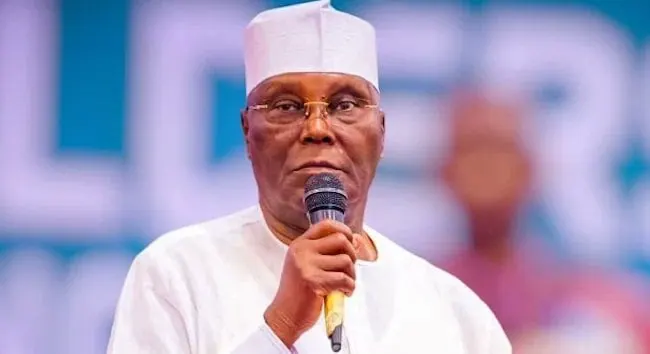
Former Vice President Atiku Abubakar has expressed support for organised labour's demand for a substantial increase in the minimum wage, stating that the recent increase from ₦30,000 to ₦70,000 has not restored workers' purchasing power. In a statement issued by Phrank Shaibu, Director of Strategic Communications of the ADC Presidential Campaign Council, Atiku criticized President Bola Tinubu's administration for presiding over a ruthless economic squeeze. He accused the government of paying workers more on paper while condoning a situation where workers live on less.
Atiku attributed the economic hardship to the removal of the petrol subsidy, which he said sent prices soaring without providing credible protection for working families. He likened the situation to providing a flimsy umbrella to workers while the rain beats down on them. According to Atiku, the government's self-congratulatory talk of reform has become an insult to Nigerians whose wages vanish between the filling station and the food market.
The former Vice President highlighted the impact of the increased cost of living on workers, stating that fuel, transport, food, and rent have devoured their earnings. He described this situation as a callous way to govern people who work hard and ask only for the means to live. Atiku also criticized Tinubu for asking Nigerians to make sacrifices and treating the suffering that followed as an afterthought.
Atiku provided an illustration of the impact of the increased petrol price on workers' wages, stating that at ₦1,400 per litre, the entire ₦70,000 monthly minimum wage buys just 50 litres of petrol. He compared this to the April 2023 national average petrol price of ₦254.06 per litre, where ₦30,000 could buy roughly 118 litres. Atiku argued that the payslip has grown, but the fuel it can buy has more than halved.
Atiku also compared Nigeria's wage floor with those of several oil-producing and African economies. Using exchange rates from July 24, 2026, he noted that Libya's monthly minimum wage was worth approximately ₦213,000; Algeria's, ₦245,000; Equatorial Guinea's, ₦302,000; and Gabon's, ₦351,000. Even Benin Republic's minimum wage stood above Nigeria's when converted at those rates.
The former Vice President emphasized that wage rules and living costs differ across countries, but those differences cannot make ₦70,000 adequate for a Nigerian worker facing today's prices. He described the Nigerian worker as the engine of the country's productive life, yet Tinubu expects that engine to run without fuel.
Atiku concluded that it is a national disgrace for workers to leave home before dawn, give the country a full day's labour, and then stand at a bus stop wondering whether the money left will pay the fare home or put food on the family table. He stated that if a full month's wage cannot sustain a worker's family, the government has failed the people.
Key points
- Atiku Abubakar criticizes Nigeria's ₦70,000 minimum wage as inadequate.
- The former Vice President attributes economic hardship to the removal of the petrol subsidy.
- Atiku compares Nigeria's wage floor unfavorably with other oil-producing and African economies.