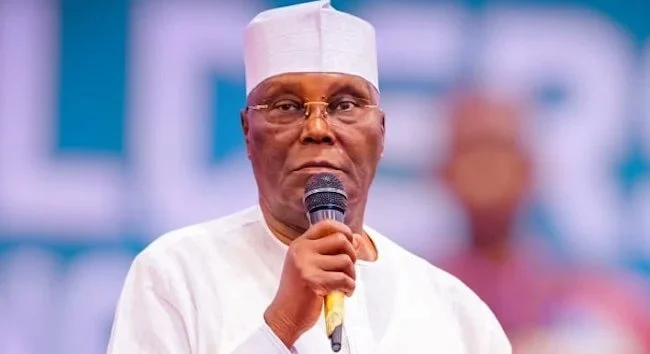
Former Vice President Atiku Abubakar has announced that 2027 will be his final presidential outing, describing it as his "last attempt" at the presidency. This admission provides Nigerians with a lens to view his increasingly frantic political manoeuvres. Atiku's decision to engage Kenneth Okonkwo as his 2027 campaign spokesperson has raised questions about his campaign's communications strategy. Okonkwo previously served as a spokesperson for Peter Obi's Labour Party campaign, where he made severe criticisms of Atiku.
The engagement of Okonkwo, who has a history of criticizing Atiku, has sparked concerns about the campaign's objective. Is the goal to communicate policy or provide an aggressive reputational makeover for a candidate with a complex political history? Atiku has also reportedly engaged a Washington-based lobbying firm to strengthen his reputational standing among U.S. policymakers and counter narratives from the Nigerian government. This considerable investment in managing the Atiku narrative has raised questions about the role of image management in his campaign.
Atiku's tenure as Vice President under President Olusegun Obasanjo from 1999 to 2007 was marked by significant responsibilities, including the National Council on Privatisation and economic policy. However, his relationship with Obasanjo deteriorated, culminating in acrimonious battles during Obasanjo's second term. Obasanjo subsequently accused Atiku of disloyalty, poor judgement, and other serious failings in his book, My Watch. These allegations remain part of the historical record and have not been erased.
The controversies surrounding Atiku's stewardship of economic portfolios, the PTDF affair, privatisation, and his confrontation with Obasanjo remain relevant to the public discourse. In August 2026, Obasanjo again publicly described his decision to select Atiku as his running mate in 1999 as the "biggest mistake" of his presidency. Atiku cannot ask Nigerians to celebrate his experience in public service while ignoring the controversies that accompanied it.
Atiku's dramatic turnaround on petrol subsidy has also raised questions about his campaign's narrative. In the 2023 campaign, he argued that petrol subsidy was unsustainable and pledged to complete its removal if elected. Today, he is declaring that he will restore it. While Nigerians are experiencing economic pressures, governance is not a popularity contest. The critical question is how the government will sustainably achieve lower prices without recreating fiscal leakages and distortions.
Atiku owes Nigerians more than attractive slogans; he owes them the arithmetic. He needs to explain where the money will come from, how much the government will spend, who qualifies, and for how long. The policy must be insulated from arbitrage and corruption, and its implementation must work within the Petroleum Industry Act. Nigerians need a comprehensive economic alternative, not just a promise to reverse difficult reforms.
The Atiku campaign's intense focus on President Bola Ahmed Tinubu has also become noticeable. As the campaign progresses, Nigerians will be watching closely to see how Atiku addresses the governance questions and presents a sustainable solution to the country's economic challenges. Atiku's proposed return to subsidy requires a transparent explanation of its fiscal implications, implementation mechanism, and long-term sustainability.
Key points
- Atiku Abubakar has announced that 2027 will be his final presidential bid.
- Atiku's campaign has invested considerably in image management, engaging a Washington-based lobbying firm and a new spokesperson.
- Atiku's turnaround on petrol subsidy has raised questions about the sustainability of his economic proposals.