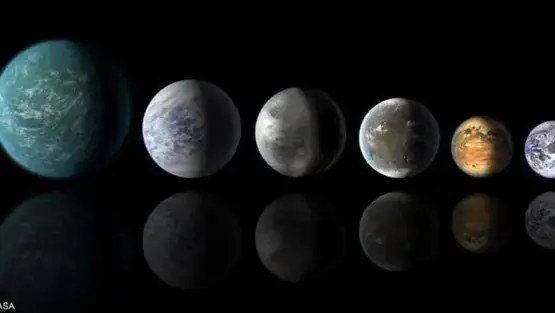
For the first time, astronomers have observed the gradual disappearance of an exoplanet outside the solar system. The exoplanet, TOI-2535b, is a "hot Jupiter" that has been visible in front of its star for years. According to the Astronomical Journal, the disappearance is caused by the gravitational interaction with another planet, resulting in a continuous and complex change in their orbital paths.
The exoplanet TOI-2535b orbits a small orange dwarf star, TOI-2535, approximately 1,100 light-years from Earth. The star is estimated to be around 9.7 billion years old. The mass of TOI-2535b is similar to that of Jupiter, but it orbits its star at a very close distance, completing one orbit in just over eight days. The planet was discovered in 2019 using NASA's TESS satellite and the transit method, which involves measuring the decrease in starlight as a planet passes in front of its star.
During a seven-year observation period, scientists noticed a gradual change in the position of TOI-2535b as it passed in front of its star. The planet's transit moved from the center of the star's disk to a higher region, then gradually approached the edge, and eventually disappeared from view in March 2026. Analysis revealed that the disappearance was not due to the planet's destruction, but rather the result of gravitational interaction with another planet.
The gravitational interaction between the two planets causes them to move into inclined and oscillating orbits, different from the traditional orbital paths observed in planetary systems. Researchers estimate that the orbital oscillation cycle will take between 30 and 50 years, resulting in changes to the viewing angle of the planets as they pass in front of the star. This leads to the appearance and disappearance of transit signals.
The discovery provides new insights into the movement of distant planets and the interactions that control their orbits. According to astronomer Samuel Yee, the planetary system discovered is characterized by a significant difference in orbital inclination between the two planets, exceeding five degrees. This is unusual, as most planetary systems have planets with similar orbital inclinations.
The researchers suggest that the two planets formed and moved to their current positions from the protoplanetary disk. However, the reasons for the large orbital inclination remain unclear, making the TOI-2535 system an important subject for further study of gravitational interactions and the evolution of planetary systems outside the solar system.
The study's findings were published in the Astronomical Journal, providing a unique opportunity for scientists to understand the complex interactions within planetary systems. Further research is needed to determine the long-term effects of gravitational interactions on the orbits of exoplanets and their stars.
Key points
- Astronomers observe the disappearance of exoplanet TOI-2535b due to gravitational interaction with another planet.
- The exoplanet's disappearance is caused by changes in its orbital path, resulting from gravitational interaction with a companion planet.
- The discovery provides new insights into the movement and interactions of distant planets outside the solar system.