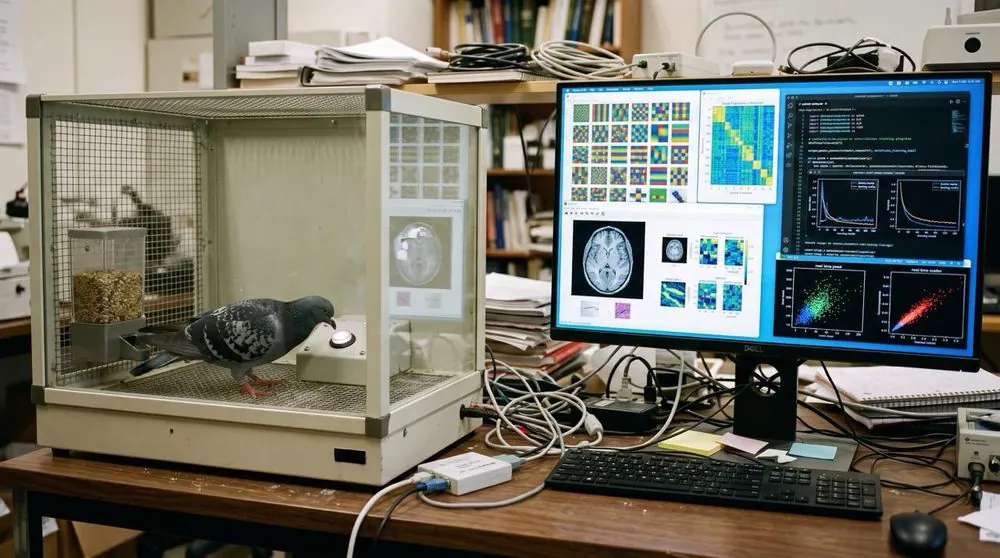
A recent analysis has revealed that artificial intelligence (AI) and pigeons share similar problem-solving methods. Both rely on trial-and-error, pattern recognition, and massive data memorization to solve complex tasks. This approach is different from humans, who use logic, rule-based reasoning, and abstract deduction. Pigeons, despite being considered to have low intelligence, excel at visual memorization and can quickly spot complex patterns.
The cognitive abilities of pigeons and AI were compared to those of rats, which are considered to be highly intelligent small animals. Rats possess exceptional problem-solving skills and can outperform dogs in complex visual and physical puzzles. They also have excellent spatial memory, allowing them to map out environments and evade predators strategically. This advanced internal psychology enables rats to operate closer to human cognition than pigeons or AI.
Pigeons and AI rely heavily on their capacity to store data, which AI uses to generate statistical predictions. Through repetition, pigeons gradually improve their performance on specific tasks, while AI mirrors this iterative learning process on a much larger scale. However, neither AI nor pigeons possess abstract reasoning, and they do not understand why an answer is correct; they only recognize that a specific input yields a specific outcome.
The comparison between pigeons, AI, and rats highlights the differences in cognitive abilities between species. While pigeons and AI may be able to solve problems through trial-and-error, they lack the advanced reasoning and abstract thinking abilities of humans and rats. This analysis raises questions about the capabilities and limitations of AI and its potential applications.
The use of AI in various industries, including business and supply chain distribution, is becoming increasingly popular. South African enterprises are adopting digital tools, AI, and agentic technologies to mitigate supply chain disruptions and build trade resilience. This trend highlights the growing importance of AI in solving complex problems and improving efficiency.
The differences in problem-solving methods between humans and AI have implications for the development of AI systems. While AI may be able to process vast datasets and draw accurate operational conclusions, it lacks the advanced reasoning and abstract thinking abilities of humans. This limitation may impact the ability of AI to solve complex problems that require creative thinking and innovative solutions.
The analysis of the problem-solving methods of pigeons, AI, and humans highlights the unique cognitive abilities of each species. While pigeons and AI may share similar problem-solving methods, they differ significantly from humans. Understanding these differences is essential for the development of AI systems that can effectively solve complex problems and improve efficiency in various industries.
Key points
- Artificial intelligence and pigeons use similar problem-solving methods, relying on trial-and-error and pattern recognition.
- Humans, on the other hand, use logic, rule-based reasoning, and abstract deduction to solve problems.
- The comparison between pigeons, AI, and rats highlights the differences in cognitive abilities between species.