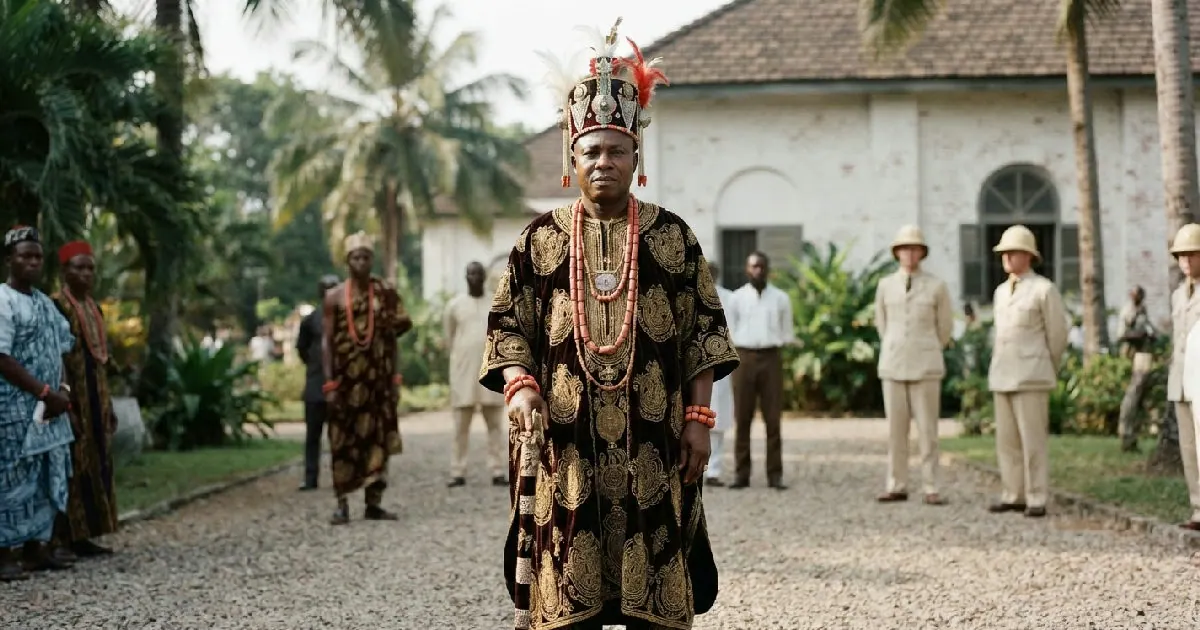
An archival photograph of Oputa II, Obi of Aboh, has been discovered in the Edward Harland Duckworth Photograph Collection at Northwestern University's Melville J. Herskovits Library of African Studies. The image, likely taken in Ijebu-Ode, shows Oputa II standing outdoors, adorned with a distinctive hat featuring plumes and intricate beadwork. This formal presentation highlights the public role of a traditional ruler whose position had already navigated significant political and economic transformations.
The Kingdom of Aboh, situated strategically along the lower River Niger in present-day Delta State, flourished as a vital centre of commerce and political authority. Its geographical advantage made it a crucial intermediary, linking communities in the Niger hinterland with extensive commercial networks that stretched towards the Niger Delta and the Atlantic coast. The river served as an essential conduit for the movement of people, agricultural produce, and manufactured goods.
During the nineteenth century, Aboh's rulers and merchants commanded considerable influence within these regional trading networks. The kingdom played a role in the Atlantic slave trade and later transitioned to become a significant centre for palm-oil commerce. Control over trade translated directly into wealth and political clout, essential for maintaining alliances with neighbouring communities. Obi Ossai I, who died in 1844, was a notable ruler who exerted substantial commercial and political sway along the lower Niger.
Following Obi Ossai I's death, the kingdom entered an eighteen-year interregnum from 1844 to 1862, which marked a significant shift in Aboh's political landscape, coinciding with increasing European penetration into the Niger hinterland. Historian Femi J. Kolapo argues that this prolonged succession crisis was deeply linked to the transformation of regional commerce. European merchants began establishing direct trading relationships with communities beyond Aboh, thereby eroding the kingdom's long-held position as a commercial middleman.
By the time Oputa II ascended the throne in 1916, Aboh existed within a profoundly altered political environment: the established British colonial system. The years leading up to his reign saw sweeping changes across Southern Nigeria, with British colonial expansion reshaping relationships between indigenous kingdoms and European authorities. The amalgamation of Northern and Southern Nigeria in 1914 had formally established the Colony and Protectorate of Nigeria.
The traditional government of Aboh was never solely about the monarch's personal power. Historical scholarship highlights the influence of titled chiefs and other established authorities, especially during periods when the throne was vacant. Offices such as the Oduah, for instance, held important responsibilities for the installation of an Obi. These institutions reveal a wider political and ceremonial structure that underpinned royal succession.
Oputa II's distinctive appearance in the archival photograph offers a window into how the Aboh monarchy projected its continued public identity. His plumed and beaded hat, along with other ornaments, was more than mere decoration; it was a potent symbol. Royal attire in many Nigerian cultures serves as a powerful expression of traditional identity, cultural continuity, and the public position of its wearer.
Key points
- The photograph of Oputa II, Obi of Aboh, was likely taken in Ijebu-Ode, hundreds of kilometres from his traditional seat on Nigeria's lower River Niger.
- The Kingdom of Aboh was a vital centre of commerce and political authority, playing a significant role in the Atlantic slave trade and palm-oil commerce.
- Oputa II's reign was shaped by the British colonial system, which had established the Colony and Protectorate of Nigeria in 1914.