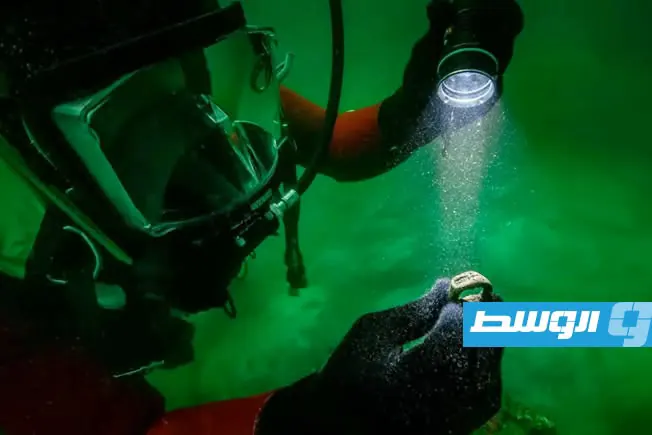
A joint archaeological mission between the European Institute for Maritime Archaeology and the Egyptian Ministry of Antiquities has made a significant discovery in the sunken port of Alexandria. The team uncovered a bronze ring with an engraving of the historic Lighthouse of Alexandria, one of the Seven Wonders of the Ancient World. The ring was found in the submerged island of Antirrhodus, which was part of the royal district and harbor of ancient Alexandria.
The discovery was announced by the Egyptian Ministry of Antiquities, which described it as one of the most significant recent underwater archaeological finds. The ring is believed to have been used as a seal, with the engraving of the lighthouse serving as an official mark. According to experts, the design of the engraving is similar to images of the lighthouse on Roman coins from the 2nd century AD.
The archaeological mission, led by French underwater archaeologist Franck Goddio, has been conducting research in the area since 1992. The team has made several significant discoveries, including the remains of a Ptolemaic-era palace, a temple dedicated to the goddess Isis, and numerous ceramic and glass artifacts. These finds have shed new light on the history of Alexandria and its importance as a major cultural and commercial center in the ancient world.
The bronze ring is considered a rare and significant find, not only for its artistic value but also for its historical importance. According to experts, the ring may have been used for administrative purposes, possibly related to the management of the lighthouse or the port. Further study is needed to confirm this theory.
The discovery of the bronze ring has sparked renewed interest in the history of Alexandria and its cultural heritage. The city's rich history dates back to the 4th century BC, and it was once a major center of learning and culture. The Lighthouse of Alexandria, built in the 3rd century BC, was one of the most iconic landmarks of the ancient world.
The Egyptian Ministry of Antiquities has announced plans to continue excavations in the area, with the aim of uncovering more secrets about the city's ancient past. The discovery of the bronze ring is a significant addition to the country's rich cultural heritage, and it is expected to attract more tourists and scholars interested in ancient history.
The archaeological mission has highlighted the importance of preserving underwater cultural heritage sites, which are often threatened by erosion and human activities. The discovery of the bronze ring serves as a reminder of the significance of these sites and the need for continued research and conservation efforts.
Key points
- The bronze ring with an engraving of the Lighthouse of Alexandria is a rare and significant archaeological find.
- The discovery sheds new light on the history of Alexandria and its importance as a major cultural and commercial center in the ancient world.
- The archaeological mission plans to continue excavations in the area to uncover more secrets about the city's ancient past.