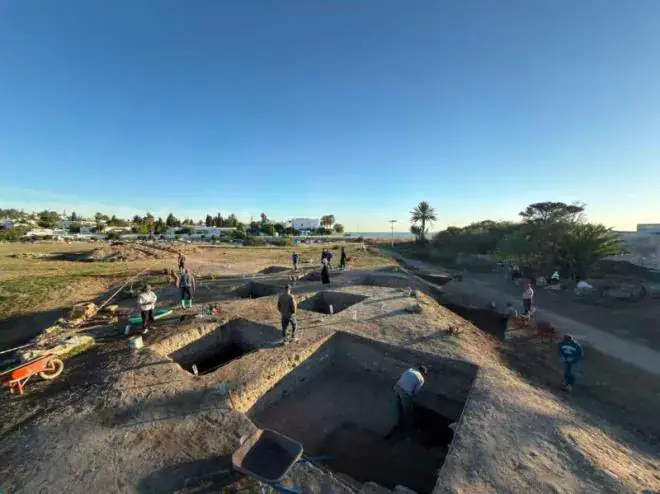
Archaeological excavations at the Punic ports in Carthage, Tunisia, have led to the discovery of a Roman-era fortification wall and several ancient artifacts. The excavations, which began on October 19, 2026, are a collaborative effort between the National Institute of Heritage and the Chinese National Center for Archaeology. The fortification wall is believed to be part of the outer wall of the circular harbor, while the stone blocks may have been used to construct a wavebreaker.
The excavations have uncovered a range of artifacts, including ceramics, oil lamps, and bronze coins, which suggest that the site was continuously occupied from the Punic period to the Byzantine era. These findings provide valuable insights into the history of the site and its significance in the ancient world. The excavations are ongoing, with workers carefully documenting and preserving the artifacts and architecture.
The project is part of a broader effort to study the archaeological components of the Punic ports in Carthage and their historical development. The Tunisian Ministry of Cultural Affairs is overseeing the project, which aims to deepen our understanding of the site's history and significance. The excavations are also providing new information about the engineering and architectural features of the ancient harbor.
The site is of great historical significance, as it was an important center of trade and commerce in the ancient world. The Punic ports in Carthage were a major hub for maritime trade, and the site has yielded many important archaeological finds over the years. The current excavations are helping to shed new light on the history of the site and its role in the ancient world.
The collaboration between the Tunisian and Chinese teams is an important aspect of the project, as it brings together experts from different countries and disciplines to study the site. The project is also providing opportunities for training and capacity-building for Tunisian archaeologists and heritage professionals.
The excavations are ongoing, with workers using a range of techniques to uncover and preserve the artifacts and architecture. The site is being carefully documented, with photographs, drawings, and other records being used to create a detailed picture of the site's history and significance.
The discovery of the Roman-era fortifications and artifacts is a significant find, as it provides new insights into the history of the site and its role in the ancient world. The project is an important contribution to our understanding of the cultural and historical heritage of Tunisia and the Mediterranean region.
Key points
- The excavations have uncovered a Roman-era fortification wall and several ancient artifacts, including ceramics, oil lamps, and bronze coins.
Reporting sources
- Radio Tunisie Culture · Radio Tunisie Culture