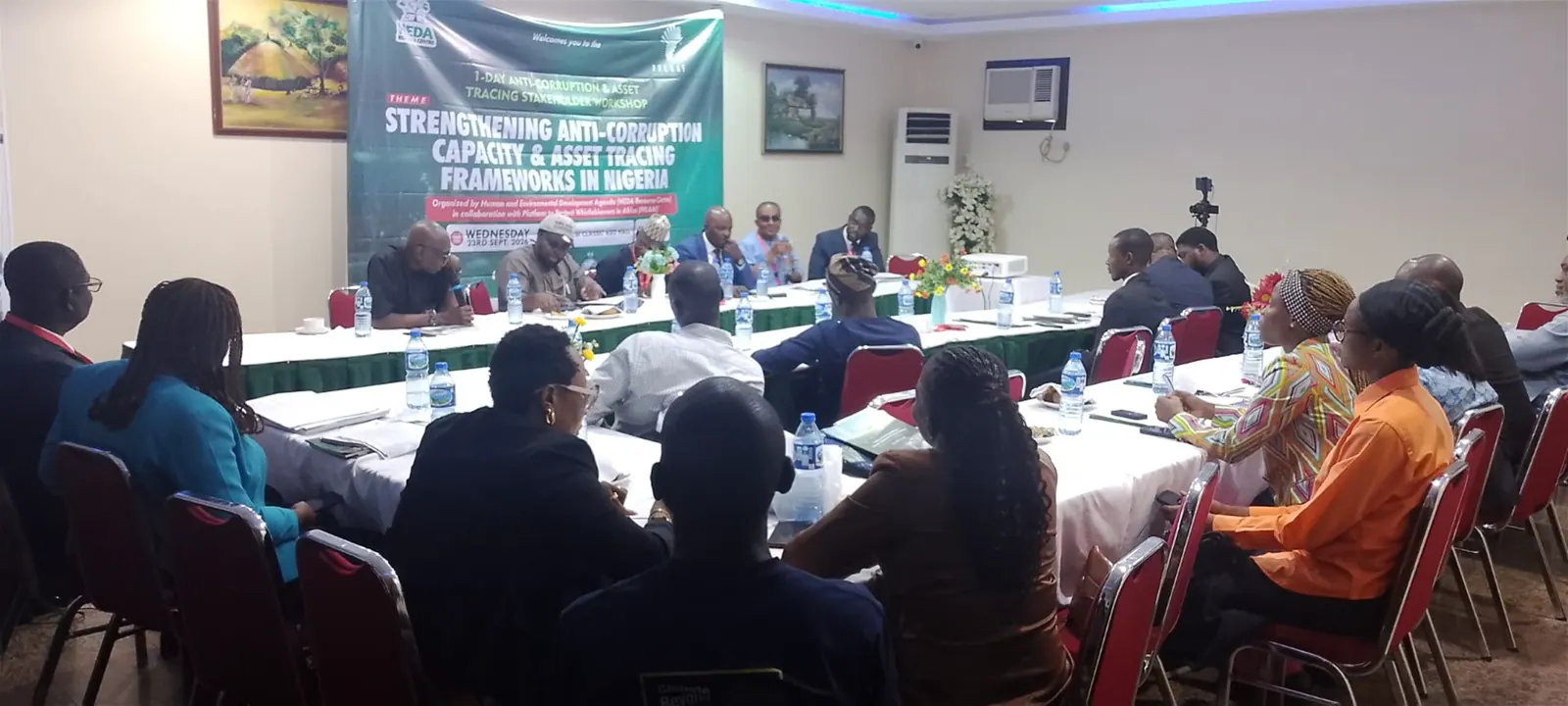
Civil society organisations and anti-corruption agencies in Nigeria have urged for stronger legal protection for whistleblowers to enhance the country's fight against corruption and improve the tracing and recovery of illicit assets. This call was made during a stakeholders' workshop in Abuja, where participants emphasized the importance of whistleblowing as a tool for exposing corruption. However, they noted that inadequate protection leaves individuals who provide information vulnerable to reprisals.
The workshop, organised by the Human and Environmental Development Agenda (HEDA) Resource Centre and the Platform to Protect Whistleblowers in Africa (PPLAAF), brought together various stakeholders to discuss ways to improve asset tracing, recovery, and public accountability. The event highlighted the threats posed by illicit financial flows, systemic corruption, and the concealment of stolen public assets to Nigeria's economic stability, public infrastructure, and national security.
The Executive Secretary of HEDA, Arigbabu Sulaimon, noted that the nature of financial crime has undergone a significant revolution over the past two decades, with traditional methods of siphoning public funds evolving into sophisticated global networks. He emphasized the need for a joint action plan to establish concrete protocols for inter-agency intelligence sharing and asset recovery to strengthen the fight against corruption.
A technical session at the workshop focused on leveraging open-source intelligence and community-led mechanisms to tackle illicit assets and public expenditure, as well as enhancing institutional protections and safe reporting channels for whistleblowers. Participants included representatives from civil society and public institutions, who emphasized the importance of whistleblowing and regretted that Nigeria lacks a dedicated whistleblower protection law.
The panel noted that countries such as Ghana, Liberia, and Senegal have established legal frameworks for protecting whistleblowers, and called for action to pass a Whistleblower Protection Bill currently before the National Assembly. They also examined the role of beneficial ownership information in tracing assets hidden through companies and identified real estate as a major area of concern.
Another panel discussed the challenges faced by institutions involved in tracing and recovering illicit assets, including access to information and evidence gathering. They stressed the importance of access to reliable beneficial ownership information and stronger links between databases and institutions holding relevant information.
The workshop concluded with a call for closer cooperation between anti-corruption agencies and the Corporate Affairs Commission (CAC) to compare records and identify possible discrepancies. The participants also proposed a unified system to bring relevant ownership information together and make it easier to identify individuals behind companies and trace hidden wealth.
Key points
- - Whistleblowing is a crucial tool in fighting corruption, but whistleblowers in Nigeria lack adequate protection. - A Whistleblower Protection Bill is currently before the National Assembly, and its passage is being called for. - Stronger coordination between anti-corruption agencies and access to reliable beneficial ownership information are essential for effective asset tracing and recovery.