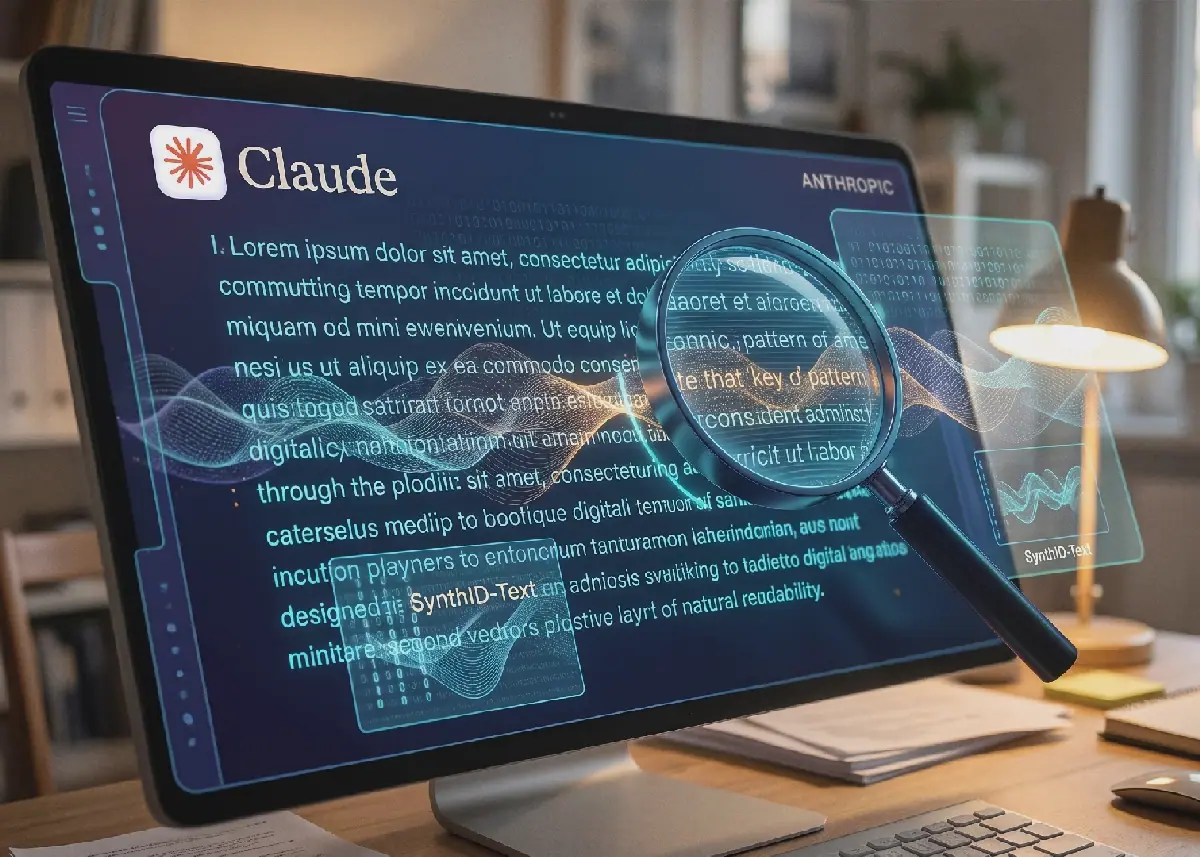
Anthropic, a leading AI developer, is expanding its text watermarking technology across more Claude models. This update, effective November 3, 2026, will cover several models, including Claude Mythos 5, Claude Opus 4.7, Claude Opus 4.6, and Claude Sonnet 4.6. The rollout on Amazon Bedrock is expected to take a few additional days. This technology allows for the identification of AI-generated writing without visibly altering the responses users receive.
The text watermarking method used by Anthropic is based on SynthID-Text, published by Google DeepMind. It works by using a secret digital key to guide word choices in AI-generated text, creating a subtle pattern that can be detected with a special detector. This approach does not add characters or extra tokens, nor does it affect the quality and readability of the text. According to Anthropic, the watermark costs nothing more to run and is designed to be invisible to readers.
The introduction of this technology is part of Anthropic's efforts to comply with the EU AI Act. As a result, the watermarking will be applied worldwide, as Anthropic currently cannot scope it by region. The company emphasizes that the watermark carries no information that could trace text back to a user, organization, or conversation. This ensures user privacy while providing a way to identify AI-generated content.
Anthropic's detection API, which can identify the watermark, is currently in private preview. It is available to eligible organizations such as regulators, media outlets, fact-checkers, and researchers. However, spotting the watermark by eye is not possible, as there are no visible symbols, odd spacing, or hidden characters. The API requires Anthropic's key, making it inaccessible to the general public.
The effectiveness of the watermarking technology has limitations. Short passages may not offer enough word choices for a reliable reading, while factual passages and light proofreading may leave little for the watermark to attach to. A positive result indicates that Claude was likely involved at some point, but it does not specify whether it wrote, edited, or translated the text.
Anthropic notes that a full rewrite will remove the mark, and a missing mark does not necessarily mean that a person wrote the text. For everyday users, the change goes unnoticed, while giving Anthropic and its partners a probability-based way to judge whether Claude contributed to a piece of writing. This technology is part of Anthropic's ongoing efforts to develop and implement AI responsibly.
The expansion of text watermarking across more Claude models is a significant step for Anthropic. Newer models, such as Claude Opus 5.5, already carry the same watermark, and older models launched before August 2, 2026, are being brought into line over the coming months. Additionally, files such as images receive signed C2PA provenance metadata instead of a text watermark, demonstrating Anthropic's comprehensive approach to AI-generated content identification.
Key points
- Anthropic expands text watermarking to more Claude models to identify AI-generated writing.
- The watermarking technology is based on SynthID-Text and is designed to be invisible to readers.
- The detection API is in private preview, available to eligible organizations such as regulators and researchers.