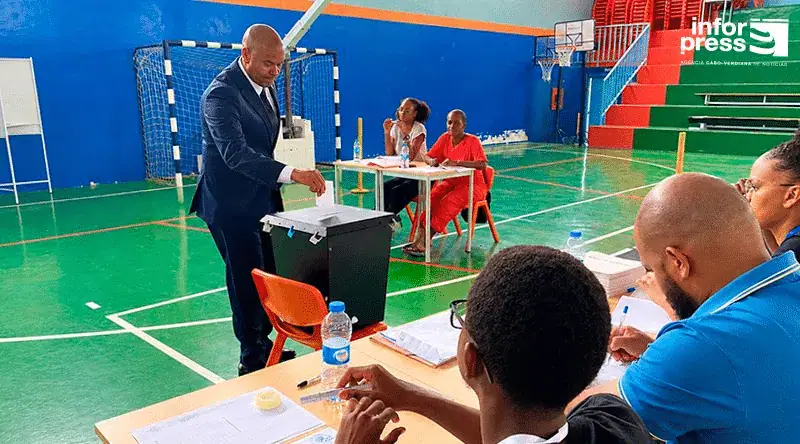
Antero Tavares, a 58-year-old judge from the Praia municipality, exercised his right to vote at the Miraflores school in the Palmarejo Grande neighborhood of Praia. He expressed his conviction that he would be elected in the first round, maintaining the same expectation that marked the beginning of his electoral campaign. Tavares emphasized the importance of civic participation, encouraging Cape Verdeans to go to the polls to bring about change in the country.
Tavares predicted that abstention would significantly decrease in these elections, attributing this to his candidacy representing an alternative and the sentiment of change expressed during campaign activities. He stated that during his campaign, he heard a clear call for change, which he believes will lead to more voters turning out. As a result, he expects a lower abstention rate.
The candidate criticized the high expenses incurred by politicians during the campaign, calling them inadmissible and incongruous. He suggested that these resources should be channeled into resolving social problems in the country. Tavares plans to follow the election results from home with his family before heading to his campaign headquarters to announce his victory and deliver a speech.
Antero Tavares is the first candidate on the official list of candidatures approved by the National Elections Commission (CNE). His political project focuses on social inclusion and sustainable development, prioritizing the needs of communities and populations facing difficulties in accessing opportunities. Tavares advocates for a presidency that is closer to citizens, capable of addressing social concerns and reducing regional asymmetries.
The presidential election features six candidates, including Tavares, Casimiro de Pina, José Maria Neves, Gilson Alves, Joana Rosa, and Loisito Sousa. Over 200 international observers are monitoring the election, representing organizations such as the Economic Community of West African States (ECOWAS), the African Union (AU), and the Community of Portuguese Language Countries (CPLP).
A total of 419,448 voters are registered for the election, with 343,065 in the national territory and 76,383 abroad. The voting process takes place at 1,302 polling stations, with 1,059 in the national territory and 243 in the diaspora. If no candidate obtains more than half of the valid votes, a second round will be held on November 29.
Cabo Verde has had five presidents since gaining independence from Portugal in 1975, including Aristides Pereira, António Mascarenhas Monteiro, Pedro Pires, Jorge Carlos Fonseca, and José Maria Neves, who won the last election in 2021 with 51.75% of the votes. According to the Constitution, the president is elected by universal and direct suffrage by registered citizens in the national territory and abroad.
Key points
- Antero Tavares expresses confidence in winning the presidential election in the first round.
- The election features six candidates, with over 200 international observers monitoring the process.
- A total of 419,448 voters are registered for the election, with polling stations set up in the national territory and abroad.