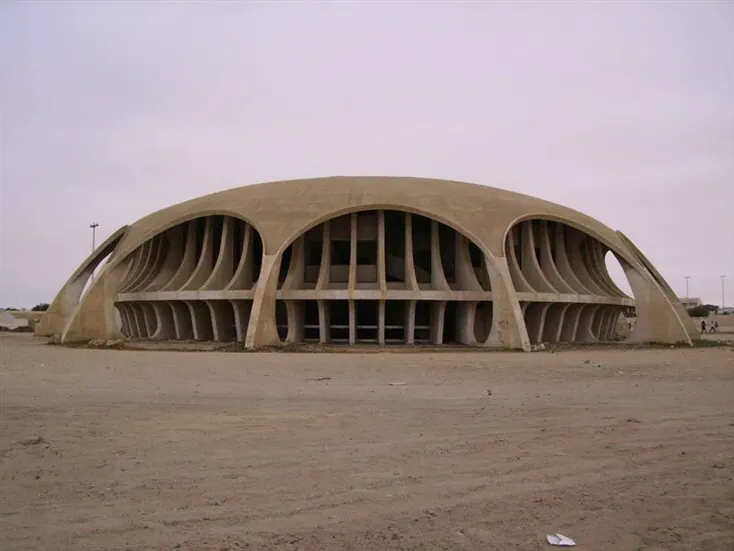
Angolan architecture has undergone significant transformations over the past 50 years, marked by continuities, systems inherited from previous regimes, and descontinuities. The history of this period is one of rupture and continuity, institutionalization and informality, appropriation, and transformation. The Law n.º 43/76, which inscribed certain forms of property, production, and management of space in the new political and institutional framework of the Angolan State, is a particularly relevant moment in this process.
The informal sector has played a significant role in the production of territory and inhabited space in Angola. However, it is essential to go beyond the automatic association between informality, poverty, disorder, or illegality. Informality represents a specific condition of space production, where access to land, parceling, construction, financing, infrastructure, licensing, and building transformation occur partially or entirely outside formal state regulation and intervention mechanisms.
The history of Angolan architecture is also marked by the relationship between formal and informal, urban and rural, center and periphery, planned and unplanned. These conditions intersect and coexist, producing specific configurations where population, territory, mobility, economy, construction, and ways of living interact. The mu seke, often used as a synonym for poor neighborhoods or informal occupation, requires specific investigation to understand its territorial and historical formation, transformation, and permanence.
A significant gap in the knowledge produced about Angola is the need for an in-depth anthropology of dwelling. It is essential to study systematically the relationships between family, territory, mobility, economy, construction, kinship, memory, religion, work, and space to understand how populations produce, transform, and attribute meaning to the places where they live. No single discipline can explain the complexity of the Angolan territory; therefore, architecture, urban planning, anthropology, geography, history, sociology, and economics must establish consistent relationships for joint research and production.
The production of knowledge about Angola requires not only accumulating information but also constructing conceptual, methodological, and scientific tools to interrogate this reality. This need leads to another absence that marked the first 50 years: the lack of a continued and consistent culture of public debate on architecture. Despite initiatives, publications, exhibitions, interviews, and discussions, a strong foundation for a public sphere of Angolan architecture has not been consolidated.
The absence of a public debate culture on architecture has consequences for the production of knowledge. What is not discussed hardly transforms into culture; what is not published hardly becomes a reference; what is not criticized hardly produces thought. Angolan architecture has often been confined to the materiality of the work, when it should also be a matter of cultural, scientific, political, and social debate.
Understanding Angola requires producing knowledge rooted in its specificities, rather than depending permanently on categories imported from distinct historical, cultural, and territorial contexts. The challenge is to overcome the limitations of the past 50 years and build a new perspective on Angolan architecture that takes into account its complexities and specificities.
Key points
- The history of Angolan architecture over the past 50 years is marked by complexity and a mix of formal and informal production of space.
- The informal sector has played a significant role in the production of territory and inhabited space in Angola.
- There is a need for an in-depth anthropology of dwelling to understand how populations produce, transform, and attribute meaning to the places where they live.