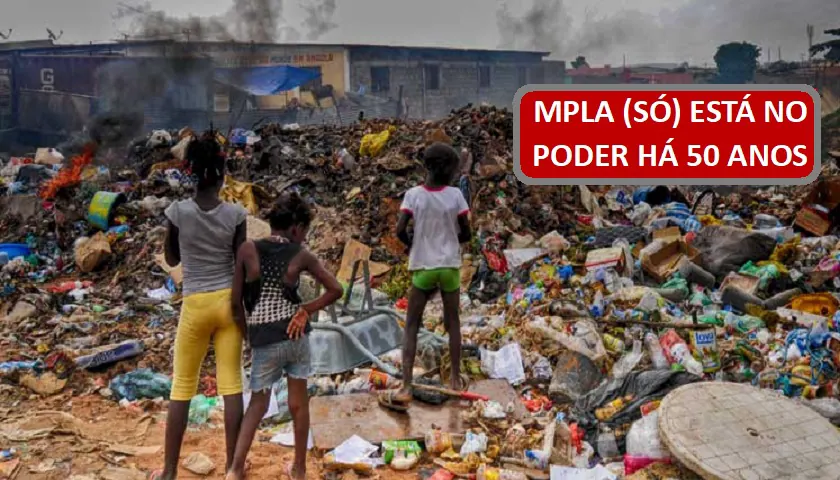
Angola, governed by the MPLA for 50 years, faces a substantial waste management issue, producing 8.3 million tons of solid waste yearly, with only 24% being collected. This leaves a deficit of 6.2 million tons, according to the Annual Report on Urban Solid Waste 2025 presented by the National Agency for Solid Waste. The report considers a crucial technical instrument for understanding, planning, and decision-making on waste management.
The province of Luanda leads in solid waste production due to its high population density, followed by Huíla, Huambo, Benguela, Bié, Uíge, Cuanza Sul, Cunene, Lunda Norte, and Icolo e Bengo. Luanda has the highest collection rate at 80%, with some open dumping sites but not permanent ones. Other provinces with high collection rates include Namibe (70%), Cabinda (71%), and Benguela (51%).
The majority of waste in Angola consists of solid waste (57%), followed by plastics (17%), paper and cardboard (9%), metals (6%), glass (4%), textiles (4%), and others (3%). Domestic sources generate 65% of the waste, while commercial, construction, industrial, agricultural, institutional, petroleum, and mining activities contribute 15%, 8%, 5%, 3%, 2%, 1%, and 1%, respectively.
Recycling initiatives in Angola are still limited, but Luanda has a sustainable program underway. The city has 15 companies using recyclables as raw materials, eight involved in installing ecopoints, and 273 ecopoints installed. However, other provinces have minimal recycling activities. Only 10% of the total waste produced is recycled, with most ending up in open dumps or disposed of improperly.
The report highlights that Luanda, Bengo, Cuanza Norte, Cuanza Sul, and Benguela are at high risk of contamination by cholera. In contrast, Huambo, Bié, Cubango, Cuando, Moxico, Moxico Leste, and Lunda Sul are considered low-risk areas. The consultant for the National Agency for Solid Waste, Rui da Silva, emphasized the need for proper waste disposal and treatment centers in all provinces.
Rui da Silva identified the lack of waste treatment centers and inadequate legal framework as significant challenges in waste management. He suggested that a supportive legal tool could help improve waste management by facilitating the contracting of operators. Additionally, he stressed the importance of environmental education to raise awareness about proper waste disposal.
The situation demands attention to environmental education, as the country lacks the capacity for information and awareness about waste management and disposal. The report and experts' statements underscore the need for a comprehensive approach to address Angola's waste management challenges and promote sustainable practices.
Key points
- Angola produces 8.3 million tons of solid waste annually but only collects 24%.
- The majority of waste in Angola comes from domestic sources (65%).
- Recycling initiatives are limited, with only 10% of the total waste produced being recycled.