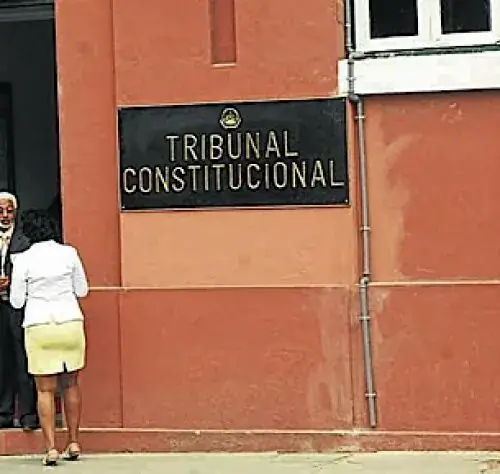
The internal crisis within Angola's FNLA party has deepened with the holding of two separate congresses, each electing a different leader. The party's situation has now been placed before the Tribunal Constitucional (TC), which must analyze the legality and conformity of each process in accordance with the Lei dos Partidos Políticos. This development comes after a tumultuous period for the party.
On November 26, the faction supporting Nimi-a-Nsimbi announced his re-election as president with 772 votes at the 6th ordinary congress. This followed an extraordinary congress in October that elected Carlito Roberto, son of the party's founder Holden Roberto, with the support of the central committee. The central committee faction submitted its documentation to the Tribunal Constitucional within the 45-day legal timeframe, seeking validation and notation.
Ndonda Nzinga, the newly elected secretary-general of the party, criticized the congress that re-elected Nimi-a-Nsimbi as a "pura mascarada" (pure masquerade), alleging that it included phantom members of the central committee. Nzinga emphasized that the truth will be revealed in the Tribunal Constitucional and expressed concerns that adventurers could lead the historic party to ruin.
Nzinga also challenged the stance of former FNLA president Lucas Ngonda, who supports Nimi-a-Nsimbi and argued that the extraordinary congress did not have the authority to elect the party president. Nzinga countered that Ngonda himself was elected at an extraordinary congress in 2010, citing the party's statutes.
Nimi-a-Nsimbi, upon his re-election, stressed that the FNLA is not a family inheritance and that all members should have equal rights and opportunities. He advocated for the importance of experience and youth participation within the party, emphasizing that longevity should translate to experience and that youth should be given a chance for renewal and greater involvement.
The Tribunal Constitucional had earlier issued a ruling (acórdão 1134/2026) that upheld a provisional measure moved by Ndonda Nzinga and others against Nimi-a-Nsimbi, leading to the convocation of the 6th ordinary congress. The Ministério Público had supported this measure, citing the breach of statutory rules and the risk of jeopardizing the FNLA's participation in the 2027 general elections.
The FNLA now awaits the Tribunal Constitucional's decision on the legitimacy of the two congresses and their outcomes. The party's internal divisions and the court's ruling will likely have significant implications for its future and its ability to participate in upcoming elections. The situation remains a critical test for the party's leadership and internal cohesion.
Key points
- The Tribunal Constitucional must decide on the validity of two FNLA congresses that elected different leaders.
- The internal crisis within the FNLA party has deepened with the holding of two separate congresses.
- The party's situation has now been placed before the Tribunal Constitucional.
Reporting sources
- Tribunal Constitucional com "batata quente" para decidir... · novojornal.co.ao