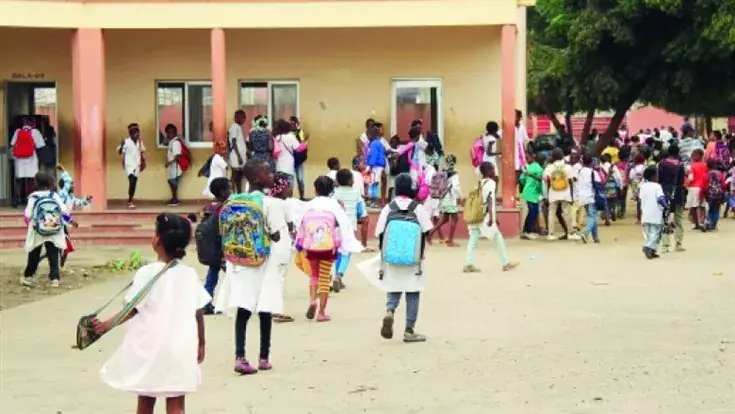
Angola's education system has undergone significant reforms since gaining independence 51 years ago. The most recent reform, led by Law No. 17/16, extended compulsory education from six to nine years. However, despite this progress, concerns remain about the system's inclusivity. The introduction of new policies, such as the "Escolas de Referência" project, has raised questions about whether these initiatives are creating a more segregated education system.
Critics argue that these reference schools concentrate resources and privileged conditions, leaving most public schools to face severe structural problems. The implementation of national exams has also been criticized for ignoring the deep-seated inequalities in schooling conditions among students. These disparities significantly impact academic performance, with students from reference schools having better material and pedagogical conditions. As a result, concerns arise that these policies may benefit some students at the expense of others.
The statistics on access to education also raise concerns. According to the Social Statistics Yearbook (2017-2022) and the President's recent speech on the State of the Nation, there has been a 6% reduction in primary school enrollment, from 6,109,998 in 2017 to 5,735,467 in 2026. Furthermore, the 2024 General Census of Population and Housing reports that over 2.4 million children of primary school age are out of school, an increase from 1.9 million in 2018. These numbers question the government's ability to ensure universal access to education.
The material conditions of schools also reveal significant disparities. A 2022 mapping of public schools in Angola found that out of 90,285 classrooms, 19,618 were provisional, 7,585 were improvised, and 10,929 were annexed. Additionally, over 81% of schools lack electricity, 66% lack piped water, and 62.25% lack functional sanitation facilities. These conditions demonstrate that simply getting students into school is not enough; they must also have the necessary material and pedagogical resources to learn and complete their studies.
The distribution of schools also perpetuates inequalities. Although 73% of public schools are located in rural areas, many are far from students' homes. For example, 54% of public schools are over two kilometers away from students' residences, and 94% of students rely on walking to get to school. These factors show that geographic location and economic status continue to influence educational opportunities.
The issue of physical disability is another challenge. Despite progress in special education, many public schools still have architectural barriers, including a lack of access ramps and handrails. The 2014 Global Evaluation Report of the Education Reform found that almost all public schools lacked access ramps. This situation highlights that inclusivity requires more than just expanding the school network; it also demands accessible conditions for all students, regardless of physical ability.
Finally, the issue of language remains a challenge. Although Portuguese is the official language, it is not the first language for many Angolans. The 2024 census found that less than 50% of the population has Portuguese as their mother tongue. A predominantly monolingual teaching model may disadvantage students whose first language is different from the language of instruction, limiting their learning opportunities. This situation is particularly relevant for ethnic groups like the Khoïsan, who face obstacles to educational inclusion due to language and cultural barriers.
Key points
- Angola's education system still struggles with inequality and inaccessibility 51 years after independence.
- The country's education reforms have been criticized for creating a more segregated system.
- Material conditions and language barriers continue to hinder equal access to quality education.
Reporting sources
- 51 anos depois, a escola angolana é para todos? (2) · novojornal.co.ao