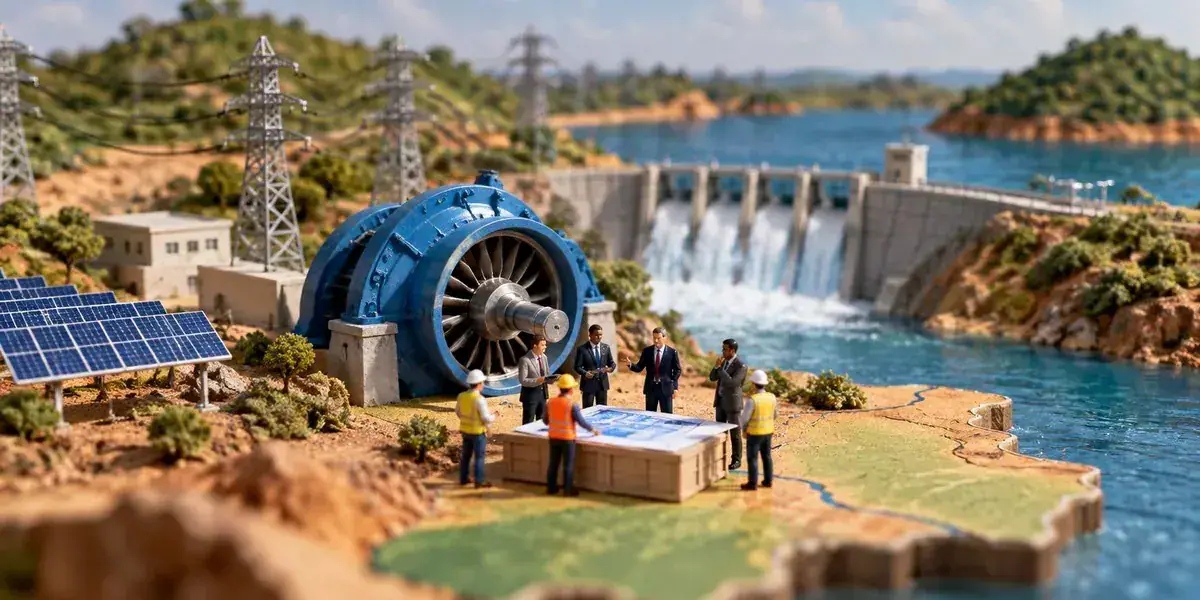
Angola and China have taken a significant step in their energy cooperation, moving from broad intent to a defined project pipeline. The two countries agreed to establish a joint working group for power and water investments during a meeting between Angolan Energy and Water Minister João Baptista Borges and Wang Hongzhi of China’s National Energy Administration in Beijing on November 3-4, 2026.
The working group will identify priority projects eligible for funding and prepare a memorandum of understanding for future cooperation. Discussions covered various areas, including hydropower, solar photovoltaics, electrification, policy coordination, and technical exchanges. China has identified these three technology areas as matching Angola’s core needs, which include increasing generation capacity, strengthening transmission networks, and expanding rural electrification.
The joint working group is expected to give the relationship a clearer delivery structure, aligning public priorities, Chinese contractors, and financing partners around a shared project list. This development is significant, as it provides lenders and contractors with a defined route into the next phase. Angolan Minister Borges called for a multi-year implementation plan, prioritizing staff training, technology transfer, and modernizing Angola’s national power grid.
Angola has been actively pursuing parallel partnerships abroad, including an investment mission to South Korea in October 2026, to widen its pool of potential technology partners. The China Machinery Engineering Corporation (CMEC) is among the firms positioned to benefit from the new structure. The working group may also open roles for companies active in engineering, construction, and equipment supply across both power and water infrastructure.
Investors will be watching closely to see whether the working group produces a ranked project list and the terms of the memorandum and its financing model. The inclusion of water infrastructure adds a separate investment channel alongside power generation, while grid upgrades may widen the addressable market for distribution equipment suppliers.
Minister Borges held separate discussions with POWERCHINA and China Gezhouba Group Corporation on accelerating strategic energy and water projects, focusing on execution speed and next steps for major infrastructure works, including the Caculo Cabaça hydropower scheme on the Cuanza River. The Caculo Cabaça project is Angola’s most significant near-term power milestone, with commercial generation targeted for 2027 and full construction scheduled for completion in August 2029.
The Caculo Cabaça hydropower project serves as a visible marker for Angola’s expanding renewable capacity and a concrete test of Sino-Angolan delivery discipline. The project’s milestones include the agreement on the joint working group on November 3-4, 2026, and the targeted commercial generation in 2027. The successful completion of this project will be crucial in demonstrating the effectiveness of the partnership between Angola and China.
Key points
- The joint working group will identify priority projects eligible for funding and prepare a memorandum of understanding for future cooperation.
- The Caculo Cabaça hydropower project is Angola’s most significant near-term power milestone, with commercial generation targeted for 2027.
- The partnership between Angola and China aims to increase generation capacity, strengthen transmission networks, and expand rural electrification.
Reporting sources
- Angola China energy deal targets hydropower pipeline · FurtherAfrica