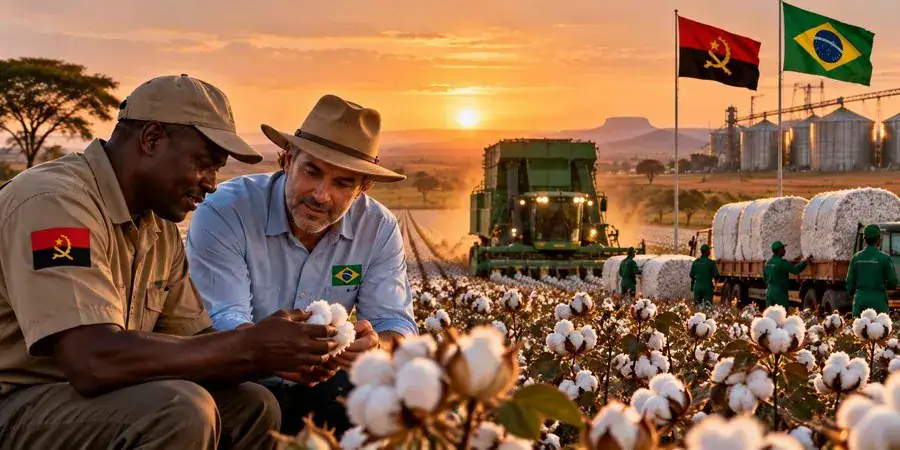
Angola is revamping its cotton sector with the help of Brazil, leveraging the latter's expertise, technology, and capital to increase production and become a significant player in the agricultural market. The partnership aims to address the country's food import reliance and expand domestic production. According to sector data, Angola's cotton output reached only 3,300 tonnes of seed cotton across 5,836 hectares in 2024, far below its 100,000-tonne annual target set under a 2014 cotton-recovery plan.
The Angolan government's efforts to revitalize the cotton sector involve regulatory changes, including the use of genetically modified seeds, which is expected to create demand for seed suppliers, agronomic services, irrigation equipment, and cotton processing infrastructure. To ensure success, reliable farm-level execution is crucial, requiring improvements in land preparation, rural finance, storage, roads, and technical skills. Local ginning and textile links are also vital to retain value within Angola.
On September 17, 2026, Brazil expressed its willingness to share expertise with Angola on cotton production, processing, quality analysis, and exports. The bilateral engagement involved the Angolan Ministry of Industry and Commerce and the Development Bank of Angola. Brazil brings extensive experience in tropical agriculture, mechanization, and large-scale farm management, which will be beneficial to Angola's agricultural development.
The cotton cooperation is part of a broader bilateral framework, as Angola and Brazil signed a memorandum of understanding on agricultural and livestock cooperation on September 15, 2026, in Luanda. The agreement covers various areas, including grain and cereal production, livestock, genetic improvement, agricultural machinery, storage, bio-inputs, and scientific cooperation between research institutions. Key crops under the agreement include beans, rice, soybeans, and peanuts.
The memorandum identifies the Terra Lunda project, a 20,000-hectare grain-production pilot in Lunda Norte, with implementation planned from 2027 and phased development through 2030. The project aims to bring Brazilian investors and operating knowledge directly into Angola, supporting a shift from commodity imports towards domestic production and processing. This presents opportunities for investors beyond primary farming, including inputs, equipment leasing, logistics, cold storage, warehousing, and food processing.
The Development Bank of Angola is expected to play a potential role in the project financing structure. Commercial terms, land-use arrangements, and project finance will determine how quickly commitments become operating assets. Brazil's research institutions may also support crop trials, seed development, and technical assistance, further enhancing the partnership's potential.
The cooperation between Angola and Brazil has the potential to transform Angola's agricultural sector, making it an attractive market for Brazilian operators and institutional investors. With the right execution, Angola can become a significant player in the regional agricultural market, reducing its reliance on imported food and increasing domestic production.
Key points
- Angola aims to increase its cotton production to 100,000 tonnes annually.
- The partnership with Brazil covers various areas, including grain and cereal production, livestock, and genetic improvement.
- The Terra Lunda project is a 20,000-hectare grain-production pilot in Lunda Norte, set to start in 2027.