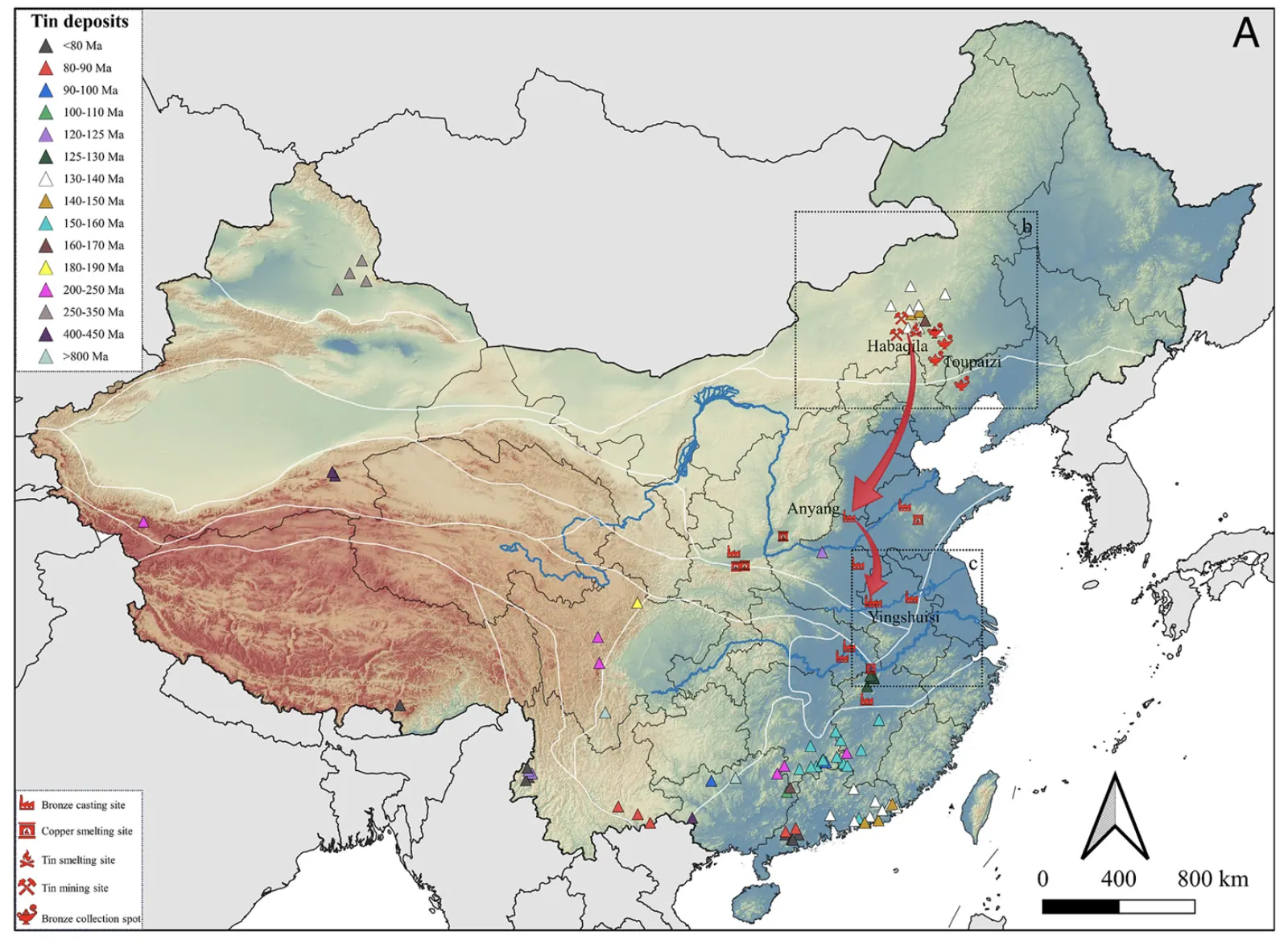
Archaeologists have made a groundbreaking discovery in northern China, uncovering a 1,500-kilometre supply network that connected the Great Hinggan Range in northeastern China to bronze-making communities in the south during the Bronze Age. The discovery was made possible by examining a bronze tripod discovered in northern China, which contained sand-like grains of cassiterite, the mineral from which tin is extracted. These grains helped scientists solve a long-standing mystery about where China's Shang dynasty obtained the tin needed for its massive bronze industry.
The study, published in the Proceedings of the National Academy of Sciences, reveals that tin was a crucial component in the production of bronze, a harder and more easily cast metal used for weapons, tools, and ritual vessels. The Shang dynasty, which ruled from approximately 1600 to 1046 BCE, produced bronze on an extraordinary scale, and securing sufficient tin presented a significant logistical challenge. According to researchers, tin was as strategic to Bronze Age societies as crude oil is today, forcing societies to establish connections far beyond their immediate territories.
The research team, led by Zhenfei Sun, a postdoctoral researcher at Peking University's School of Archaeology and Museology, used a unique approach to reconstruct the ancient supply chain. By examining mineral grains from several points along the ancient production chain, including ore discarded at the Habaqila smelting site and grains preserved inside slag from the Yingshuisi bronze-casting workshop, the team was able to determine the origin of the tin. The cassiterite grains were treated like geological birth certificates, with the team measuring the uranium and lead locked inside the crystals to determine when the original tin deposits formed.
The findings revealed that the cassiterite samples clustered between roughly 140 million and 132 million years old, matching tin mineralisation in the Great Hinggan Range. Samples from the nearby Anle deposit produced a comparable age, pointing to the Great Hinggan Range as the source of the tin found at all three sites. The journey of the tin was likely not a simple caravan travelling directly from mine to workshop, but rather a relay network with tin moving through the Shang political heartland in China's Central Plain before being redistributed southward.
The study suggests that the tin may have moved through tribute, trade, or other forms of exchange, rather than being directly controlled by the Shang state. Local pottery found in the northeastern mining communities indicates that they retained their own cultural identity, highlighting the complexity of the ancient supply chain. The research also introduces a method that could reshape research beyond China, as dating surviving cassiterite grains could help archaeologists trace ancient tin sources where conventional chemical fingerprints have failed.
However, the approach has an important limitation, as it requires unreacted cassiterite to survive, meaning it cannot be applied to finished bronze objects or completely smelted tin ingots. For Sun and his colleagues, the wider story is one of connectivity, highlighting the long-distance connections between miners, traders, political centres, and craftspeople that existed long before modern globalisation. The discovery has made the invisible network visible again, providing a unique insight into the lives of people living during the Bronze Age.
The study's findings have significant implications for our understanding of ancient societies and their economies. The fact that demand for a scarce metal like tin could link distant communities and drive the establishment of complex networks highlights the sophisticated nature of ancient economies. As researchers continue to explore the history of tin production and trade, they may uncover even more surprising examples of long-distance connectivity in ancient societies.
Key points
- The discovery of a 1,500-kilometre supply network in Bronze Age China reveals the complex and sophisticated nature of ancient economies.
- The study introduces a new method for tracing ancient tin sources, which could reshape research beyond China.
- The findings highlight the long-distance connections between miners, traders, political centres, and craftspeople that existed long before modern globalisation.