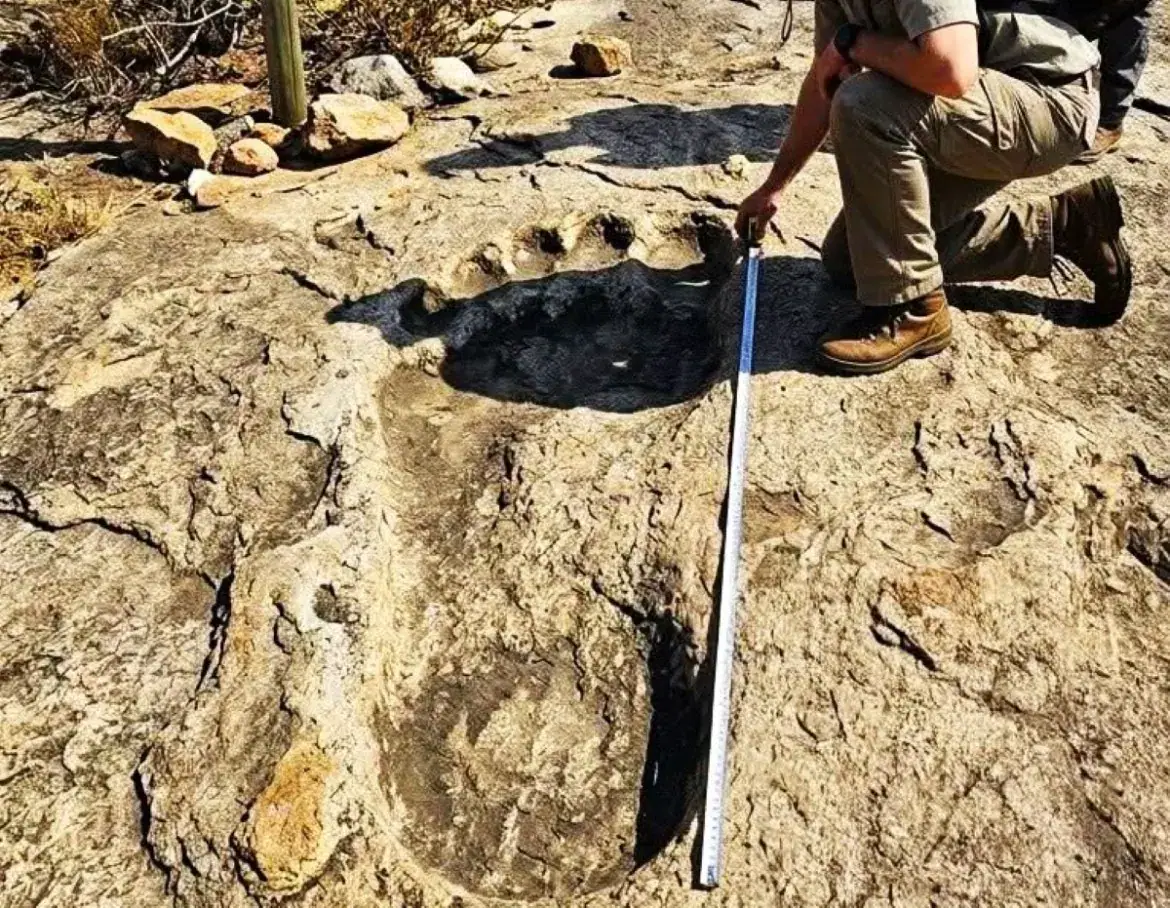
The mystery of ancient giants who left massive footprints across Africa has sparked intense debate among scientists and locals alike. In South Africa, a footprint measuring over a meter long, pressed into solid granite, has been a subject of fascination for years. The locals near Mpuluzi, Mpumalanga, refer to it as the Footprint of God or Goliath's Footprint. According to Nguni legend, a giant woman, said to be ten meters tall, was running toward her lover when a volcanic eruption killed her, leaving behind the footprint.
Geologist Robert Schoch examined the formation and concluded that it is a natural erosional feature rather than an ancient footprint. The rock itself is part of the Mpuluzi Batholith, granite that formed roughly 3.1 billion years ago, making it one of the oldest exposed crust on Earth. However, the popular version of the story gets the geology wrong, with some claiming the site is 200 million years old. In reality, the granite is vastly older, dating back billions of years, a time when complex animals did not yet exist.
Similar footprints have been found in other parts of Africa, including Kenya's central Kitui area. In Tanzania, well-defined footprints can be seen on the rocks of Mwanza and Shinyanga in the lake zone. Additionally, ordinary footprints dating nearly 4 million years ago were discovered by Mary Leakey in 1979 at the Laetoli site near Olduvai within the Ngorongoro Conservation Area of Northern Tanzania. These findings have sparked interest in the possibility of giants having existed in Africa.
Local folklore also adds to the mystique of giants in Africa. In the remote Monduli wilderness of Arusha, a legend tells the story of a man known as 'Marikino,' who slew a giant. Such stories, while not scientifically proven, contribute to the rich cultural heritage of Africa and highlight the significance of these footprints in the collective imagination.
While science may not support the existence of giants, the footprints remain a remarkable natural feature that has captured the imagination of people. The stories surrounding these footprints demonstrate the importance of preserving local legends and folklore, even as scientific explanations are sought. In many cases, the truth lies not in confirming myths but in appreciating the cultural significance of these stories.
The study of these footprints also provides valuable insights into the geological history of Africa. The formation of the rocks and the erosional features they display offer a glimpse into the continent's ancient past. As scientists continue to study these sites, they are also working to understand the cultural context in which these legends emerged.
Ultimately, the mystery of ancient giants in Africa remains a topic of fascination, with both scientific and cultural perspectives offering valuable insights. As researchers continue to explore these sites, they are also working to preserve the stories and legends that have been passed down through generations, recognizing the importance of these footprints in the cultural heritage of Africa.
Key points
- Geologist Robert Schoch concluded that the footprints are natural erosional features.
- Footprints have been found in South Africa, Kenya, and Tanzania.
- Local folklore contributes to the mystique of giants in Africa.
Reporting sources
- Mystery of Ancient giants who left massive footprints stamped onto rocks across Africa · The Tanzania Times – News from Tanzania, Africa, World, Breaking News, Weather, Environment and Climate Change