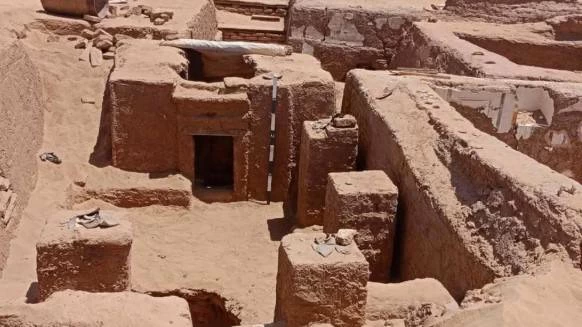
A team of archaeologists has made a significant discovery in the Western Desert of Egypt, uncovering a 1700-year-old tomb that sheds light on the burial practices of the Roman era. The tomb, built from limestone in the shape of a pyramid, is believed to belong to a high-ranking official and his wife. The site features a unique architectural style, along with rare funerary inscriptions and texts. The discovery was announced by Egyptian archaeologists, who described the tomb as a remarkable find.
The tomb was discovered with a stone slab bearing a Greek poem, which is a rare find in Egypt. The poem, consisting of 19 lines, is dedicated to a man named Bisichthes, who is referred to as a "counselor in life." The poem praises his wisdom and mentions that he was likely a judge who lived between the late 3rd and early 4th centuries AD. The poem is addressed to Bisichthes by his son Sarapion, who asks him to accept the offerings made by his children as they inherit his legacy.
The tomb's architecture is a blend of Egyptian and Greek styles, reflecting the cultural diversity of the Western Desert during the Roman era. The site features a 14-step staircase leading to the main entrance, which is adorned with a decorated stone panel in Egyptian hieroglyphics. The entrance leads to a hall with walls made of brick covered in plaster, where two burial sites were discovered. The tomb also contains a variety of artifacts, including pottery, a bronze coin featuring Emperor Constantine, and a limestone basin for washing.
The discovery of the tomb provides valuable insights into the burial practices of the Roman era in Egypt. The presence of Greek inscriptions and Egyptian hieroglyphics highlights the cultural exchange and diversity of the time. The tomb's unique architecture and artifacts suggest that the deceased was a person of high status, and the poem provides a personal and emotional glimpse into the life of the family.
The Western Desert of Egypt has yielded many significant archaeological discoveries in recent years, and this tomb is no exception. The site provides a fascinating glimpse into the lives of the people who lived in the region during the Roman era. The discovery of the tomb and its contents is a significant addition to our understanding of ancient Egyptian history and culture.
The Greek poem found in the tomb is a rare and significant find, as it provides a personal and emotional glimpse into the life of the family. The poem's use of Greek language and Roman-era references highlights the cultural exchange and diversity of the time. The poem also provides a unique insight into the values and traditions of the family, who placed great importance on the burial practices and the legacy of their loved ones.
The discovery of the tomb has generated significant interest among archaeologists and historians, who are eager to learn more about the lives of the people who lived in the Western Desert during the Roman era. The site provides a unique opportunity to study the cultural, social, and economic practices of the time, and it is expected to shed new light on our understanding of ancient Egyptian history.
Key points
- The tomb's unique architecture and Greek poem provide a rare glimpse into the burial practices and cultural diversity of the Roman era in Egypt.
- The discovery of the tomb and its contents sheds new light on our understanding of ancient Egyptian history and culture.
- The Greek poem found in the tomb is a significant find, as it provides a personal and emotional glimpse into the life of the family.