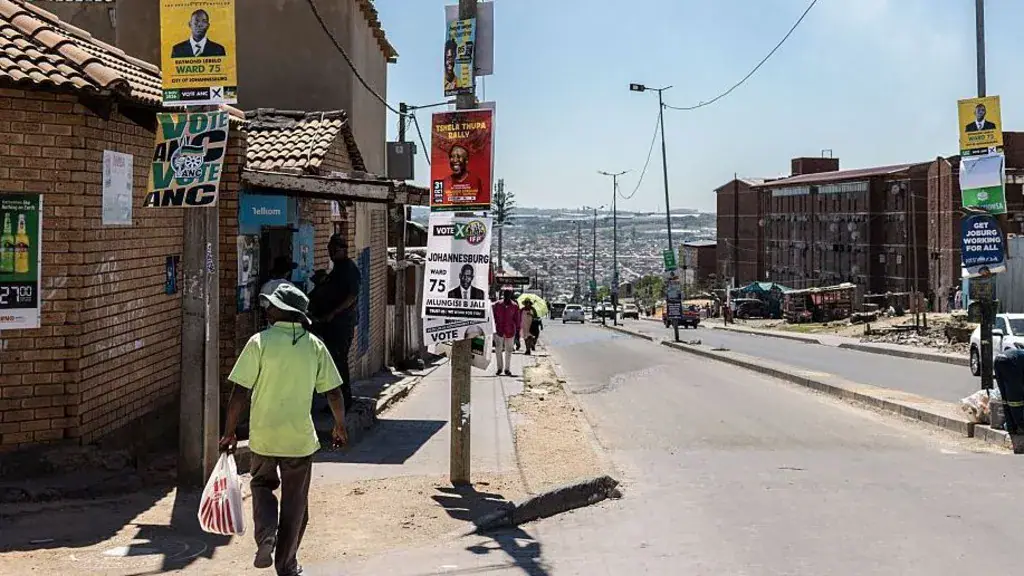
South Africans are voting in highly contested local elections that are likely to see a significant loss of votes for the African National Congress (ANC), the country's former ruling party. The elections are a chance for the ANC to prove it still has what it takes to govern, but the party has been struggling with declining support due to high levels of corruption, unemployment, and crime. The ANC had a disastrous showing in the last national election, losing its parliamentary majority for the first time since 1994.
The ANC's support has been dropping significantly over the years, from 70% of the vote in the 2004 general election to 40% two decades later. President Cyril Ramaphosa has denied that his party is in a downward spiral, but polls and pundits have predicted a further loss in these elections. Ramaphosa told supporters at the party's final election rally that the ANC is going higher and higher, and that they will show their critics on election day.
In townships like Alexandra, north-east of Johannesburg, the ANC has traditionally had a strong supporter base, but poor governance and voter apathy are unravelling this support. Residents have expressed frustration with the lack of change and deteriorating delivery of basic services, such as water, electricity, and refuse collection. Sanele Ntombela, an 18-year-old first-time voter, is excited to make his voice heard, but many of his friends have not registered to vote or do not intend to vote.
The issues plaguing Alexandra are not unique, with similar patterns of neglect and disrepair seen in other townships and municipalities across Gauteng province. A recent report by the auditor-general found that only 39 of South Africa's 257 municipalities achieved a clean audit between 2024 and 2025. None of Gauteng's three metro cities, Johannesburg, Tshwane, and Ekurhuleni, featured in this list, with Johannesburg being labelled "effectively bankrupt" due to its dire financial state.
Experts agree that all eyes will be on Africa's wealthiest city, Johannesburg, as well as the country's seven other biggest municipalities, or metros, particularly those in Gauteng, when the results come in. Of South Africa's eight metros, only three are governed by a single party, with the ANC being the largest party in coalition governments in Gauteng. Political analyst Melanie Verwoerd said the elections would be a "verdict ... and judgment" on the ANC.
Several polls point to a continued decline in support for the ANC, with one poll conducted by Ipsos putting the ANC's support at 30%, down from 46% in the last local elections in 2021. The same poll predicts a slight increase in electoral support for the Democratic Alliance (DA), especially in Johannesburg. DA leader Helen Zille has been vying for the mayoral chain in the city, with her unusual campaign attracting a lot of attention.
The local elections are a critical test for the ANC, with the party's performance likely to have significant implications for its future. The elections are also an opportunity for voters to hold their leaders accountable for the state of local governance and service delivery. As the results come in, it will be clear whether the ANC can reverse its decline and regain the trust of South African voters.
Key points
- ANC faces significant challenges in local elections due to declining support and corruption.
- Local governance and service delivery are key issues in the elections.
- The elections are a critical test for the ANC and its future.