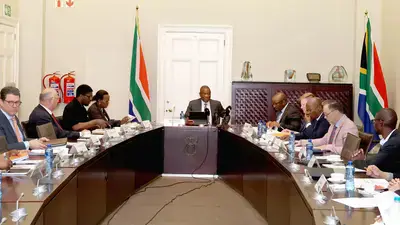
The African National Congress' (ANC) coalition model has created instability in South Africa's Government of National Unity (GNU), where the ANC is partnered with 10 other parties. This model, where the party with the largest number of votes imposes its policies and appointments, has led to continuous governing instability. The ANC's dominance has influenced all other parties, especially those spun off from it, and has resulted in a lack of collaboration and stability in coalitions.
The ANC's coalition governing model has been adopted by its spin-off parties and new parties alike, creating coalition instabilities across the country. This model is similar to those used by other African liberation movements, such as Zimbabwe's Zanu-PF and Algeria's FLN. These movements often make policies based on party interests, rather than national interests, and exclude other parties from decision-making and appointments.
The ANC's unilateral approach to policy and appointments has led to conflicts with its coalition partners, including the Democratic Alliance (DA). The DA has had to take the ANC to court over party policies and issue public statements opposing ANC decisions. This has created a situation where coalition partners are forced to be both a partner and an opposition within the governing coalition.
The ANC's behavior has also led to the undermining of non-liberation movement ministers in the cabinet. Public servants in ministries often report clandestinely back to liberation movement ministers, undermining the effectiveness of non-liberation movement ministers. This has created a situation where non-liberation movement ministers are unable to deliver effectively or upstage poor performances by liberation movement ministers.
The upcoming local government elections on November 4, 2026, are likely to deliver more coalitions at the municipal level, with up to 100 "hung councils" where no party will have a majority. South Africa urgently needs a new and more inclusive coalition governance model, which is more collaborative and stable, and can deliver public services effectively for all citizens.
The ANC's coalition model has also led to the loss of individual identities of its coalition partners. When coalition partners are forced to go along with the dictates of the leading party, their supporters are often confused, believing that their parties have been captured by the dominant party. This has created a situation where coalition partners are no longer able to differentiate themselves from the dominant party.
Experts warn that the ANC's coalition model is unsustainable and that a new approach is needed. The model has created instability and undermined the effectiveness of government. A more collaborative and inclusive approach is needed to ensure that government is able to deliver public services effectively and represent the interests of all citizens.
Key points
- The ANC's coalition model has created instability in South Africa's Government of National Unity.
- The model has led to the undermining of non-liberation movement ministers and the loss of individual identities of coalition partners.
- A new and more inclusive coalition governance model is urgently needed to ensure stability and effective delivery of public services.