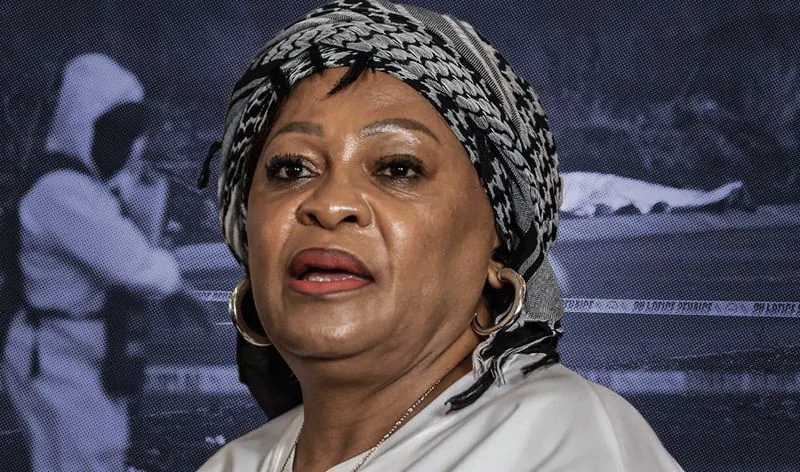
The ANC's deputy secretary-general, Nomvula Mokonyane, recently visited the families of nine femicide victims in Ekurhuleni, where she expressed empathy and assured them that the government would do everything possible to track down the killer or killers. However, she also signaled that the ANC Women's League would push for the reopening of the debate around the death penalty and the castration of sexual offenders. This comment has sparked a heated discussion about the role of capital punishment in South Africa.
The ANC Women's League secretary-general, Nokuthula Nqaba, later confirmed that the matter had been tabled at a special national executive committee meeting, with unanimous support for reopening the capital punishment conversation. Nqaba stated that while they are aware of the constitutional provisions and the right to life, they believe that the people should be allowed to discuss and decide on the issue. The League is now seeking legal opinion on how to take this matter forward, with the possibility of a referendum.
The debate on the death penalty has raised concerns about the ANC's commitment to human rights and the Constitution. The party played a significant role in drafting the country's Constitution, which abolished the death penalty in 1996. The Constitutional Court's landmark judgment at the time described the death penalty as "cruel, inhuman and degrading punishment." ANC leaders' sudden interest in reviving the debate has been seen as a populist response to rising crime rates and public anger.
Evidence suggests that capital punishment is not an effective deterrent to crime. In the 1980s, South Africa had one of the highest rates of executions in the world, yet crime rates continued to rise. The Constitutional Court's judgment in 1996 also noted that there was no proof that the death penalty had a greater deterrent effect on would-be murderers than life imprisonment. Critics argue that the focus should be on addressing the root causes of crime and improving the justice system rather than resorting to punitive measures.
The ANC's shift in stance on the death penalty has also raised concerns about the potential impact on the country's human rights record. South Africa has a history of using the death penalty as an instrument of oppression and repression during the apartheid era. The ANC's leaders, including Nelson Mandela, Walter Sisulu, and Govan Mbeki, were also facing the death penalty before the country's transition to democracy. Critics argue that reviving the debate on the death penalty undermines the country's progress in promoting human rights and dignity.
The ANC Women's League's push for the death penalty has been met with skepticism by many, who argue that it is a simplistic solution to a complex problem. Feminists, human rights activists, and others have expressed concerns that the focus on punitive measures distracts from the need to address the underlying causes of gender-based violence and femicide. They argue that the government should prioritize comprehensive solutions that address poverty, inequality, and social injustice.
As the debate on the death penalty continues, it remains to be seen how the ANC's proposal will be received by the public and the Constitutional Court. The court's 1996 judgment set a high bar for the reintroduction of the death penalty, requiring that it be shown to be a necessary and proportionate response to crime. Critics argue that the ANC's proposal fails to meet these criteria and that the focus should be on strengthening the justice system and promoting human rights.
Key points
- The ANC's revival of the debate on the death penalty has raised concerns about the country's commitment to human rights and the effectiveness of capital punishment in deterring crime.
- Evidence suggests that capital punishment is not an effective deterrent to crime, and critics argue that the focus should be on addressing the root causes of crime and improving the justice system.
- The ANC's shift in stance on the death penalty has also raised concerns about the potential impact on the country's human rights record and its progress in promoting human rights and dignity.