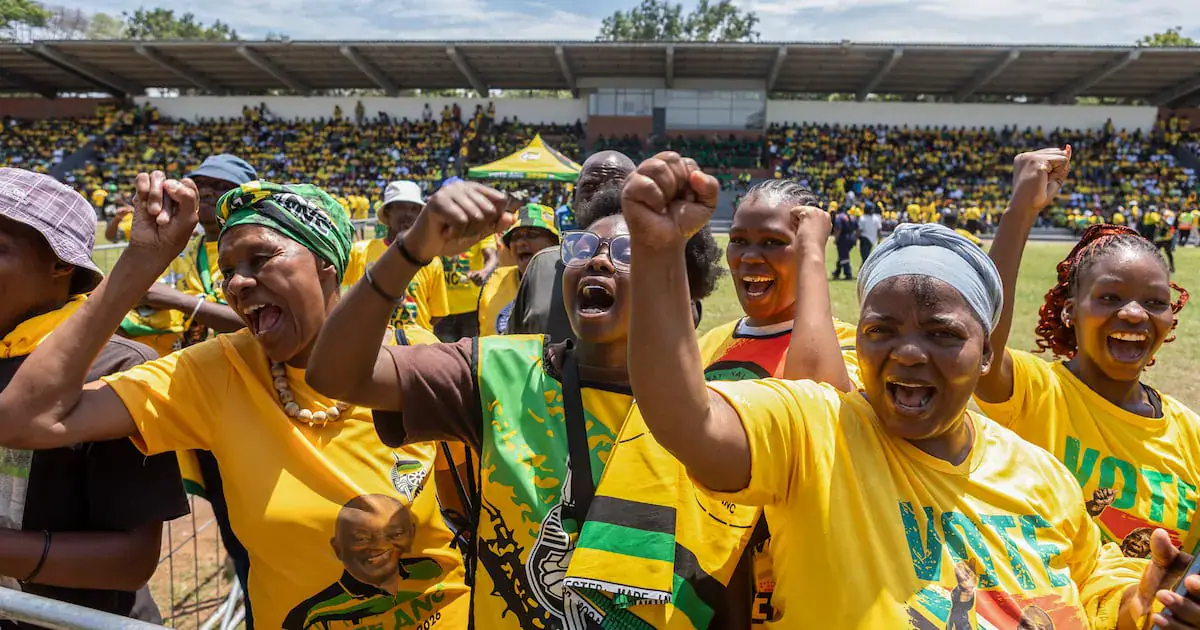
The African National Congress (ANC) is on course for a disappointing result in South Africa's major cities, according to early returns and projections from the November 4 local government elections. The party is likely to fall short of a majority in every metro and finish behind the Democratic Alliance (DA) in most of them. This marks a significant deterioration from 2021, when the ANC still held outright majorities in Buffalo City and Mangaung.
The ANC's poor performance has raised concerns about its ability to govern the country's councils without coalition deals. The party's first deputy secretary-general, Nomvula Mokonyane, said that the ANC is not expecting to disappear from the political scene, but rather to "repackage" itself. Official results are expected to be released on Sunday, but the trajectory so far suggests a contraction of the ANC's footprint in local government.
The DA is projected to finish first in at least five of the eight metros, with the ANC not expected to win a majority in any of them. According to Louw Nel, a senior political analyst at Oxford Economics, the DA is in a strong negotiating position in Gauteng province, particularly in Ekurhuleni, where it is leading with about 41% of counted votes. ActionSA is emerging as a potential coalition partner in Tshwane, with its founder, Herman Mashaba, building support in the province's townships.
The ANC's national tally is projected to register a 10% loss of electoral support, from 40% to 30% since the 2024 general elections. The party's last remaining strongholds, such as Limpopo and the Eastern Cape, are also expected to decline. In KwaZulu-Natal, Jacob Zuma's MK party is projected to redraw who governs strategic municipalities, with MK leading in the province with 33.2% of the vote, followed by the ANC with 24.8% and the IFP with 22.7%.
In eThekwini metro, MK led with 39.4%, followed by the ANC (23.5%) and the DA (23.2%). The party also secured more than 50% in Msunduzi, sweeping the capital's wards, and led the poll in Endumeni, relegating the ANC to fourth place. The Council for Scientific and Industrial Research (CSIR) election prediction model estimates that Cape Town will be the only metro that will be governed by the DA without requiring a coalition.
The CSIR estimates that the DA is set to garner above 58% of the votes in Cape Town. In Nelson Mandela Bay, the CSIR projects the DA first with 39% against 27.3% for the ANC. In Mangaung, the CSIR has the ANC ahead on 37.3% against 30.2% for the DA, with the EFF at 8.4%. The ANC won 50.6% in Mangaung in 2021, a slim outright majority then.
According to political analyst Tasneem Essop, voters are moving away from the ANC in large numbers, and regional dynamics of the votes cannot be ignored. The ANC's projected lead in Buffalo City, with 39.9%, is still a steep fall from the 59.3% it won in 2021. The party will have to negotiate coalitions to retain governing roles in the country's councils, a process that has proved unstable in cities such as Johannesburg and Tshwane.
Key points
- ANC's poor electoral performance may force it into coalition deals to retain governing roles in major cities.
- DA is projected to finish first in at least five of the eight metros, with ANC not expected to win a majority in any of them.
- MK party's strong showing in KwaZulu-Natal may lead to coalition talks to lead the government across the province.
Reporting sources
- # 3 ANC faces coalition scramble as grip on major cities slips · The Rand Daily Mail