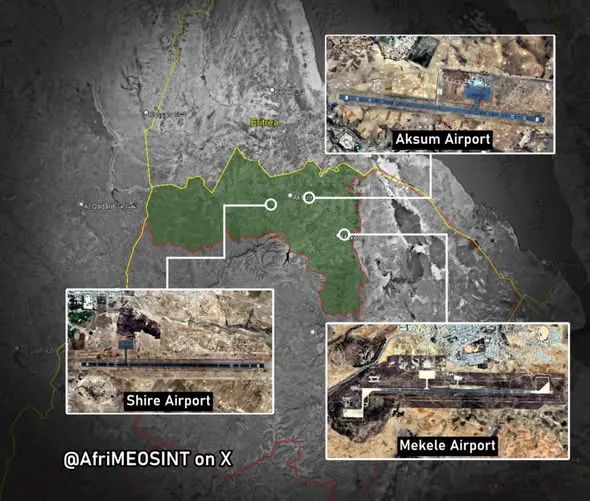
A Sudanese political analyst has warned that the escalating conflict in Ethiopia's Tigray region could have significant implications for Sudan. According to analyst Khalid Mohamed Taha, any major escalation in Ethiopia could make Sudan's war more regional and less isolatable within its borders. This comes as tensions have increased in the Tigray region after the Tigray People's Liberation Front (TPLF) seized control of the city of Mekele and suspended flights between the Ethiopian capital Addis Ababa and several airports in the region.
The conflict in Tigray has been ongoing for several months, with the Ethiopian federal government and the TPLF engaging in clashes and drone strikes. The situation has raised concerns about the potential impact on Sudan, which shares a border with Ethiopia. Taha notes that the situation is particularly worrying given that Sudan's eastern region is already unstable politically and militarily. He warns that if the conflict in Tigray were to escalate, it could lead to a resurgence of violence in areas such as the Fashqa region and southern Blue Nile.
Taha believes that the conflict in Tigray does not need to directly involve Sudan for it to have an impact. Rather, the biggest risk is that the border between Sudan and Ethiopia could become a proxy war zone, with armed groups on both sides using the border and local communities for logistical support. This, he argues, would effectively make Sudan's internal conflict surrounded by a turbulent Ethiopian front.
The developments in Tigray have been marked by a significant escalation of violence in recent days. On September 23, TPLF forces seized control of Mekele's Alwola Abba Nega airport, after reportedly neutralizing federal police forces stationed there. The Ethiopian Airlines has since suspended flights to Mekele and Aksum. Taha notes that the airport's strategic importance could increase if the conflict were to spread and air transport became a key aspect of the fighting.
A new development in the conflict is the formation of an alliance between seven armed groups opposed to the Ethiopian federal government. Taha notes that this alliance brings together groups from different regions, including Tigray, Amhara, Oromia, and Benishangul-Gumuz. While the groups share a common goal of opposing the government of Prime Minister Abiy Ahmed, they have significant differences over issues such as land, borders, and the federal system.
Taha cautions that it would be a mistake to assume that these groups will engage in a coordinated and unified military campaign. While they may be able to exert pressure on the government, their differences could limit their ability to present a united front. The analyst emphasizes that the situation in Ethiopia is more complex and volatile than it initially appears, with significant implications for Sudan and the wider region.
The conflict in Tigray has raised concerns about the potential for a wider regional conflict. With the situation in Sudan's eastern region already unstable, Taha warns that the country could be drawn into the conflict. The international community is closely watching developments in the region, with concerns about the humanitarian impact of the conflict and the potential for further destabilization.
Key points
- The conflict in Ethiopia's Tigray region could make Sudan's war more regional and harder to contain.
- The situation in Sudan's eastern region is already unstable, raising concerns about the potential for a wider conflict.
- The formation of an alliance between seven armed groups opposed to the Ethiopian federal government has added a new layer of complexity to the conflict.