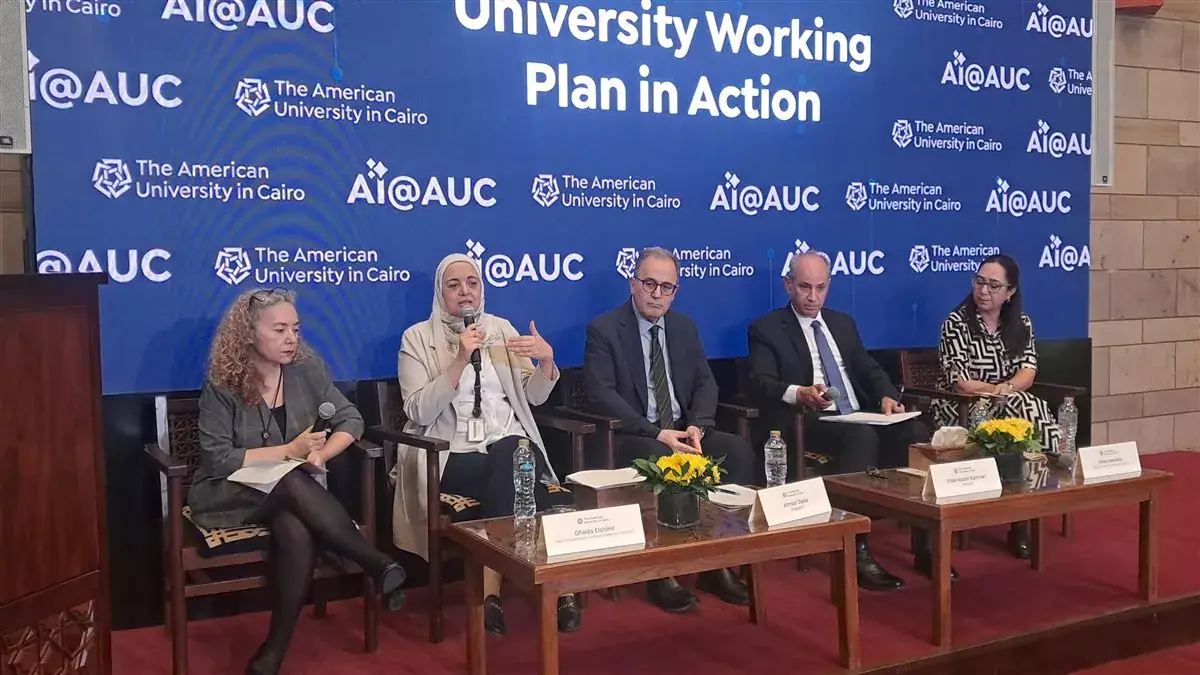
The American University in Cairo has introduced a new initiative, AI@AUC, which aims to harness the growing potential of artificial intelligence in higher education, research, and institutional work. According to Dr. Ahmed Dalal, president of AUC, the initiative represents a strategic step towards developing a university culture that uses AI in a conscious and responsible manner. The initiative has four main strategic pillars: teaching, learning, scientific research, and institutional work.
The teaching pillar of the AI@AUC initiative focuses on supporting faculty members in exploring AI capabilities and using them to develop teaching methods, design curricula, and update evaluation tools. This aims to improve learning outcomes and enhance the quality of the educational process while maintaining the integrity and independence of academic evaluation. Dr. Dalal emphasized that the goal is not to replace human thinking but to empower students to acquire the knowledge and skills needed to deal with AI in a conscious and responsible manner.
The learning pillar of the initiative aims to enable students to acquire the knowledge and skills necessary to deal with AI, understand its capabilities and limitations, and evaluate its outputs with a critical mindset. The initiative also seeks to instill principles of data protection, intellectual independence, and academic integrity. Dr. Dalal stressed that AI should be viewed as a tool to assist thinking, problem-solving, and expanding knowledge horizons, rather than a substitute for human thinking or student ability to learn, analyze, and create.
In the area of scientific research, the AI@AUC initiative offers opportunities for data analysis, exploration of new research questions, development of research methodologies, and acceleration of scientific discovery. The initiative aims to enhance the quality and impact of research, while adhering to scientific accuracy, research integrity, transparency, and professional and ethical responsibility. AUC seeks to utilize AI capabilities to strengthen research quality and expand its scientific and societal impact.
The AI@AUC initiative also addresses institutional work by exploring opportunities to use AI in developing administrative and professional processes, improving work methods, increasing performance efficiency, and reducing wasted time and resources. The initiative emphasizes the importance of adhering to data protection and privacy regulations, as well as professional standards and regulatory frameworks.
Dr. Dalal emphasized that the initiative's importance extends beyond introducing new technologies into higher education. It is linked to the university's responsibility to prepare future generations for a society where AI is increasingly present and influential. The university's role is not limited to preparing graduates who can use this technology but also to empower them to understand, evaluate, and deal with it critically.
The success of the AI@AUC initiative depends on the active participation and cooperation of AUC faculty members, students, researchers, and staff. The goal is to translate the initiative's strategic vision into practical steps and impactful initiatives that enhance AUC's role in shaping the future of education and scientific research in the AI era.
Key points
- AUC's AI initiative has four strategic pillars: teaching, learning, scientific research, and institutional work.