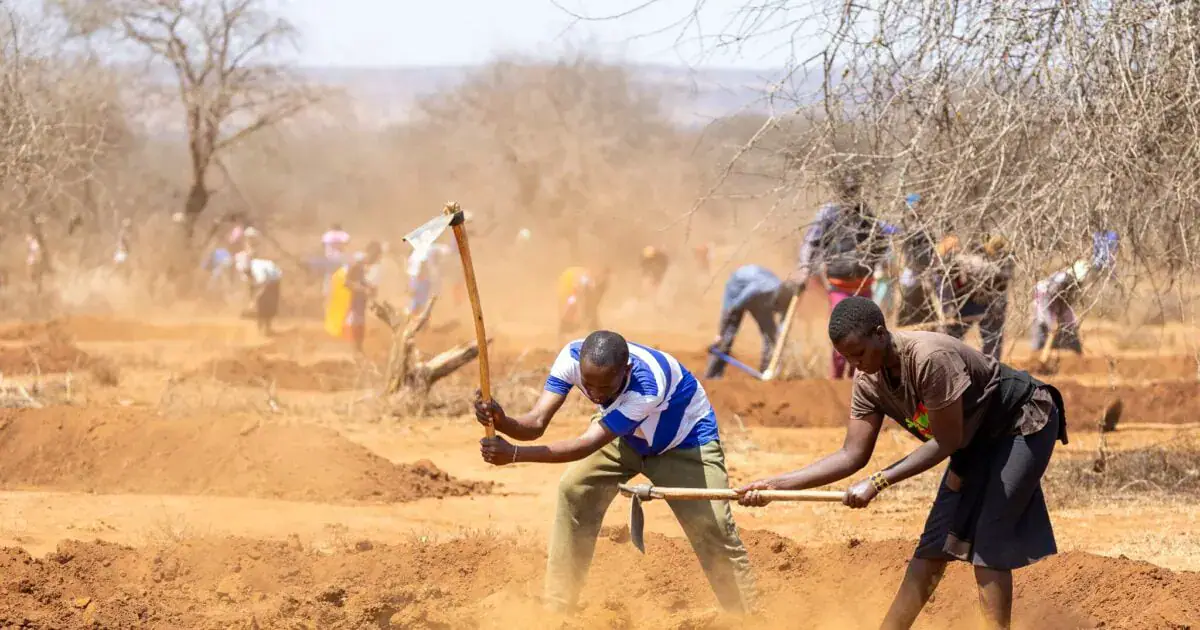
Communities around the Amboseli ecosystem have launched an initiative to build 50,000 miniature earth dams across degraded rangelands ahead of anticipated El Niño rains. The community-led restoration drive, implemented by Big Life Foundation, Justdiggit Foundation, and the TWENDE project, aims to turn heavy rainfall into renewed pasture for livestock and wildlife. Workers are digging over 1,000 bunds daily at four active sites, targeting degraded grazing areas across Mbirikani Ranch.
The initiative addresses the challenges faced by pastoralist communities in the Greater Amboseli ecosystem, who are grappling with recurring droughts, declining pasture, and increasing pressure on rangelands. Ernest Lenkoina, Rangelands Restoration Manager at Big Life Foundation, emphasized that degraded land has become a major challenge, warning that heavy rainfall could worsen land degradation where soils have lost their capacity to absorb water.
The bunds, measuring 2.5 meters by five meters, are dug in semi-circular formations along natural water-flow paths. Their basins trap rainwater, reduce erosion, and prevent gully formation while retaining valuable topsoil. Indigenous grass seeds are then scattered around the structures, allowing vegetation to take root and restore the surrounding landscape.
The current campaign builds on a five-year restoration programme by Big Life and its partners, which has constructed over 278,000 bunds across 2,300 acres of degraded land. The project has provided income to drought-affected households, with over Sh9 million paid to 657 casual workers, many of them local Maasai women.
Caroline Kerichu, Southern Landscape Manager at Justdiggit Foundation, stressed the importance of practical interventions to restore degraded landscapes. She emphasized that nature has an incredible capacity to regenerate when given the opportunity and that the role of the project is to create the right conditions and support communities.
The programme also strengthens women's economic participation through eight community grass seed banks coordinated by Big Life and managed by women's groups. The seed banks supply indigenous grass seeds for restoration activities and create additional income opportunities through seed sales, hay baling, and integrated beekeeping enterprises.
Previous restoration sites have recorded significant pasture recovery, with restored areas retaining greener vegetation for longer and providing forage for livestock and wildlife during dry periods. Communities have introduced temporary grazing restrictions to allow newly planted grasses to mature and produce seeds before livestock are reintroduced, with Community Land Management Committees and rangeland scouts monitoring the restoration areas.
Key points
- The initiative aims to restore degraded rangelands and renew pasture for livestock and wildlife ahead of El Niño rains.
- Over 50,000 earth dams are being constructed across the Amboseli ecosystem.
- The project has provided income to drought-affected households and strengthened women's economic participation.