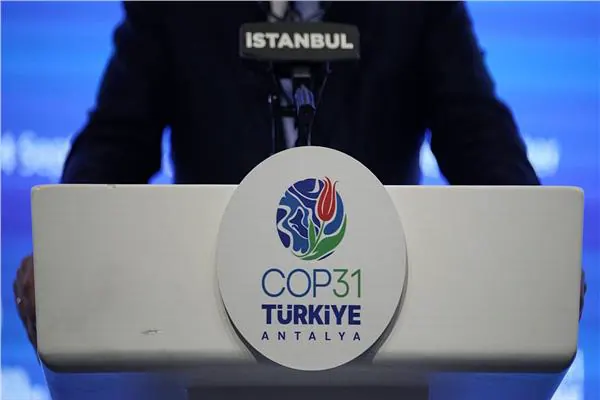
The Turkish presidency of COP31 has unveiled an ambitious package of goals, extending beyond electrification to tackle waste management, urban planning, and climate education. This move seeks to mitigate the impact of the fossil fuel crisis on households and economies. At the Bonn Climate Change Conference, Turkish President Recep Tayyip Erdogan's representative, Murat Kurum, outlined these non-negotiable objectives.
A significant focus area is the battle against waste, particularly methane emissions. Kurum announced a goal to halve global waste growth by 2035, emphasizing a "zero waste" approach. This is crucial, as food waste alone accounts for 10% of global emissions, largely due to methane, which is 80 times more potent than carbon dioxide. The initiative aims to reduce the environmental and economic burdens associated with waste.
In conjunction with waste reduction, COP31 has set a target to decrease energy consumption intensity in buildings by at least 25%. This measure is designed to protect families and businesses from soaring energy bills. The Turkish presidency is also working on new initiatives for food security, circular materials in manufacturing, and climate education, recognizing the interconnectedness of these issues.
These announcements come against the backdrop of a global energy crisis, with fuel prices skyrocketing. Kurum warned about the dangers of relying on imported fossil fuels, while International Energy Agency (IEA) Executive Director Fatih Birol noted that the crisis, coupled with rising demand for air conditioning, electric vehicles, and artificial intelligence, is propelling the world toward an "era of electricity."
The push for electrification is gaining momentum, with the International Renewable Energy Agency (IRENA) proposing a roadmap for 35% electrification by 2035. IRENA Director-General Francesco La Camera described electrification as one of the fastest and least costly solutions. Meanwhile, Bruce Douglas, head of the Global Renewables Alliance, emphasized that the real challenge lies in scaling up renewable energy deployment.
To ensure the flow of funds to support these ambitious goals, the Turkish presidency has introduced the "Climate Implementation Bridge." This initiative aims to link climate priorities with national development plans, offering technical and financial support to developing countries. The approach acknowledges the varying starting points and trajectories of nations.
The COP31 agenda seeks to bring together governments, financial institutions, cities, and civil society to create a lasting legacy, which will be further pursued at COP32 in Ethiopia. The ultimate goal is to achieve the 2035 targets, marking a significant step toward a more sustainable and climate-resilient future.
Key points
- COP31 aims to halve global waste growth by 2035 and reduce energy consumption intensity in buildings by at least 25%.