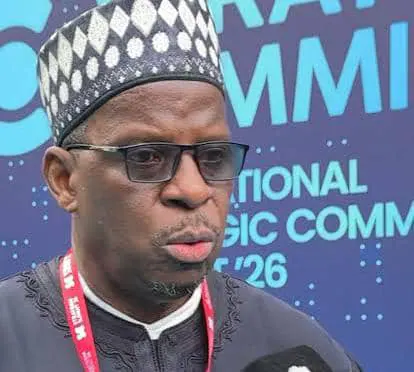
Malam Ali Muhammad Ali, Managing Director of the News Agency of Nigeria (NAN), has called for the rekindling of the vision of late Dr. Nnamdi Azikiwe, challenging Nigeria to translate the legacy of Dr. Azikiwe from commemoration to generative action. He made this statement as a Guest Speaker at the 2026 International Convention of the Nnamdi Azikiwe University Alumni Association in Abuja. The convention's theme was "Innovation, Integrity and Inclusion: Rekindling the Zik Vision for a New Era." Ali described the theme as both timely and intellectually demanding.
Ali anchored his lecture on a quote attributed to Azikiwe: "Originality is the essence of true scholarship, and creativity is the soul of the true scholar." He stated that history at certain moments ceases to be a record and becomes a sermon. According to Ali, Zik is not merely a name on a university, airport, or currency note, but an idea – that Africans could think for themselves, organise themselves, govern themselves, and claim their place in the comity of nations.
Ali highlighted Zik's achievements, noting that he was not simply a politician who became Governor-General at Independence in 1960 and first President of the Republic in 1963, but a journalist, intellectual, entrepreneur, institution-builder, and Pan-Africanist. He pointed out that for Zik's generation, the vocabulary was freedom, and that Zik understood that political independence without intellectual and economic emancipation would remain incomplete.
Ali cited Zik's establishment of the West African Pilot in 1937 as a consequential move, which became an instrument of political consciousness and disrupted the colonial Daily Times established 11 years earlier. He explained that the Pilot introduced advocacy journalism, and its motto – "Show the light and the people will find the way" – was more than a slogan, but a theory of leadership.
Linking history to the present, Ali said his stewardship represents a historical continuum, noting that from the West African Pilot to NAN, the institutional form has evolved, but the underlying Zik principle remains: information is power, and a society that cannot inform itself cannot fully govern itself. He also spoke on innovation, stating that it is older than technology and is the capacity to see possibility where others see limitation.
Ali cautioned that a university bearing Zik's name cannot afford to treat his legacy as merely ceremonial, noting that education was not preparation for employment alone, but for citizenship, leadership, and civilisation. He described integrity as "the invisible Infrastructure," adding that without integrity, institutions decay, and public office becomes private enterprise.
Ali challenged universities to manufacture what they consume, generate globally competitive patents, and asked if African science can shape African health policy and if African media can tell African stories without external validation. He concluded by stating that Nigeria must move from being primarily a market for other people's inventions to becoming a laboratory for solving its own problems.
Key points
- Malam Ali Muhammad Ali calls for rekindling of Dr. Nnamdi Azikiwe's vision to translate legacy into action.
- Ali highlights the importance of innovation, integrity, and inclusion in rekindling the Zik vision.
- He challenges universities to produce citizens who ask 'What problem can I solve? What institution can I build?' rather than 'What job can I get?'