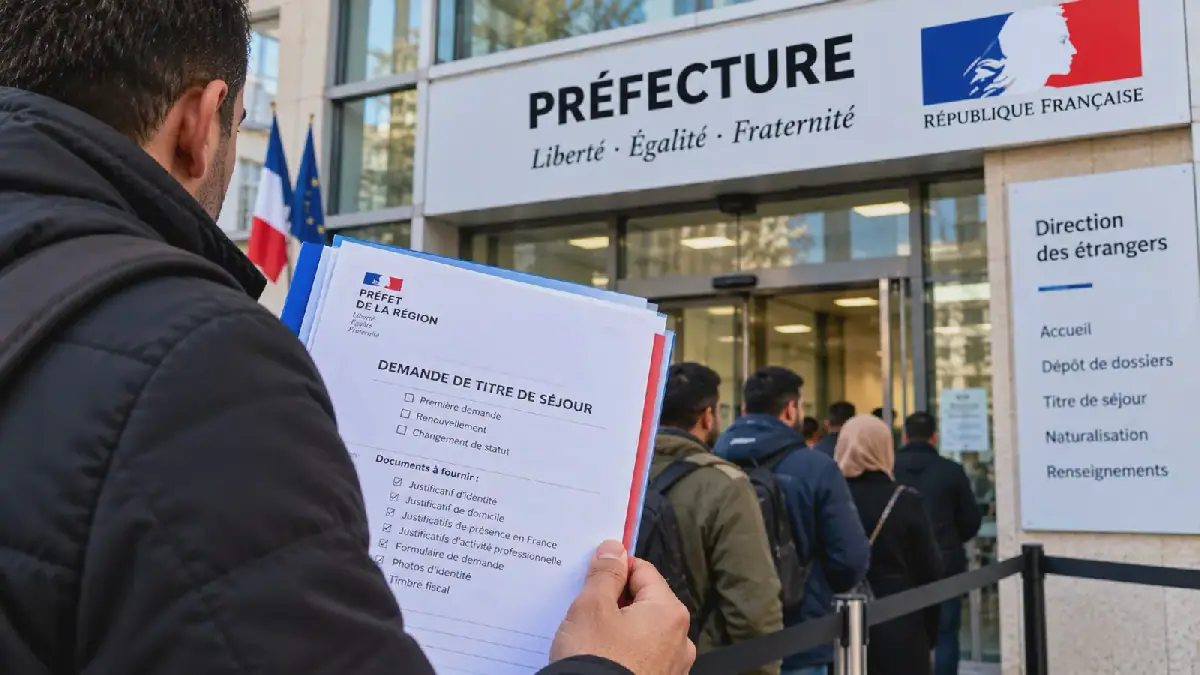
The French government introduced a regularization program for undocumented workers in high-demand professions, allowing them to apply for a temporary residence permit until December 31, 2026. To be eligible, applicants must have lived in France for three years, worked for at least 12 months in the past 24 months in a high-demand profession, and still be employed in that profession. A list of high-demand professions is defined by region.
The program, introduced by the January 26, 2024, immigration law, allows workers to apply directly at the prefecture without needing their employer's involvement. However, the prefect has significant discretion in evaluating applications, considering factors such as the applicant's integration, respect for public order, and adherence to the principles of the Republic. Despite these conditions, only 1,655 regularization requests were approved, falling short of the government's expectations of 10,000.
After December 31, 2026, the program will no longer be available, and the only remaining option for regularization will be the classical exceptional admission to residence, which also relies on the prefect's discretion. However, this process does not involve a list of high-demand professions or a minimum work requirement. Algerian workers in France are excluded from the high-demand profession regularization program due to the 1968 Franco-Algerian agreement, which governs their stay.
The 1968 agreement takes precedence over French law and regulates Algerian citizens' admission to residence comprehensively. The Conseil d'État ruled in 2010 that this agreement governs Algerian citizens' stay in France. As a result, Algerian workers employed in high-demand professions are not eligible for regularization under this program. A proposal by socialist deputies to create a four-year residence permit for essential or high-demand professions has not been adopted.
Algerian citizens have alternative regularization options. The prefect has the authority to grant a residence permit on a case-by-case basis, considering the individual's personal situation. The 1968 agreement also provides for a one-year residence permit for Algerian citizens who have been living in France for over ten years or have been students for fifteen years. Spouses of French citizens, parents of minor French children, and Algerian citizens with serious health conditions may also be eligible.
To be eligible for a "salarié" residence permit, Algerian citizens typically need a work contract approved by the employment ministry and a long-stay visa. Those already residing in France may face challenges in obtaining this permit. Algerian citizens seeking regularization should consult with specialized associations and immigration lawyers to determine the best course of action and build a strong case.
Algerian workers in France must exercise caution when seeking regularization, as attempting to use the high-demand profession program may result in a residence permit refusal and an obligation to leave the territory. With the deadline for the program approaching, Algerian workers should explore alternative options and seek professional advice to navigate the complexities of French immigration law.
Key points
- Algerian workers in France are excluded from a regularization program for workers in high-demand professions due to the 1968 Franco-Algerian agreement.
- The program will end on December 31, 2026, and Algerian workers will not be able to benefit from it.
- Algerian citizens have alternative regularization options, including a case-by-case evaluation by the prefect and residence permits for family or health reasons.