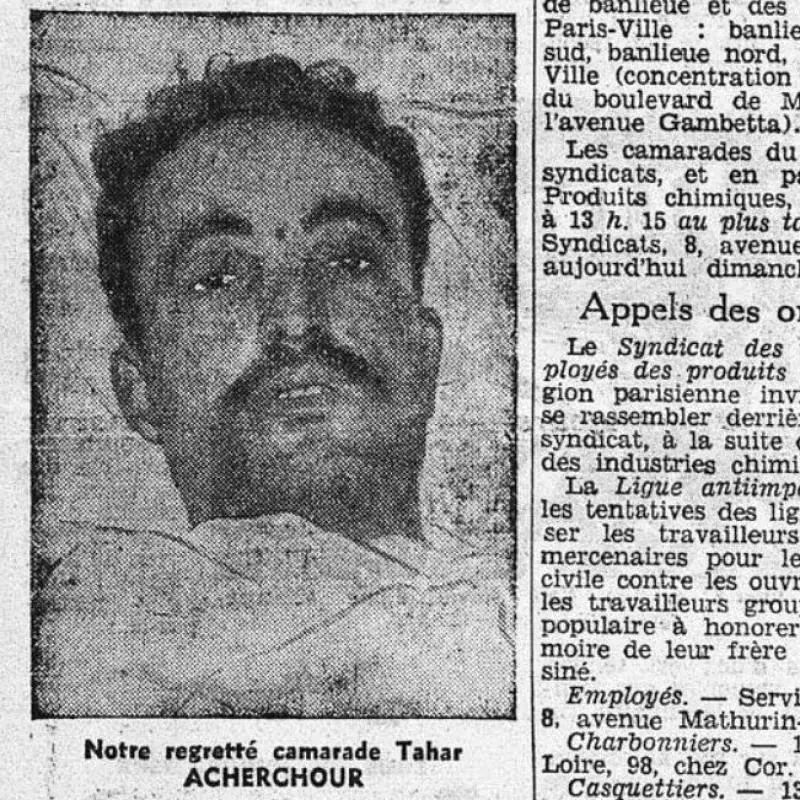
Tahar Acherchour, a 28-year-old Algerian trade unionist with the CGT, was fatally shot by Paul Cusinberche, son of the owner of the Cusinberche stearin factory in Clichy, on November 23, 1936. Acherchour died the next day from injuries sustained when Cusinberche, a far-right activist, fired two shots at him during a labor dispute. The incident occurred during a prolonged strike by factory workers demanding better wages and working conditions.
The labor dispute began in June 1936, with workers seeking a salary increase; men earned 3.75 francs per hour, while women earned 2.50 francs. After several weeks of negotiations, workers occupied the factory, leading to heightened tensions between employees and management. On the day of the incident, Cusinberche, armed with a revolver, led a group of about 20 men, including strikebreakers, into the factory, resulting in clashes with unionized workers.
The far-right activist, Cusinberche, claimed he fired shots to scare the strikers, but evidence suggests otherwise. Acherchour was hit in the arm and abdomen; doctors later reported that the bullets had perforated his liver, stomach, and small intestine. Seven other strikers were injured in the altercation. The incident sparked widespread outrage among workers and anti-colonial groups, with many accusing Cusinberche of a "fascist assassination."
The press reaction to the incident was highly polarized. Left-wing publications like L'Humanité and Le Populaire extensively covered the event, condemning Cusinberche's actions and highlighting the broader labor struggles. L'Humanité ran multiple articles and photographs, exposing Cusinberche's far-right affiliations and his role as treasurer of the 18th section of the French Social Party.
Anarchist publications also denounced the incident, characterizing it as a new form of employer aggression. The Libertaire wrote that it illustrated the need for worker self-defense and criticized the Popular Front government for tolerating such armed interventions by employers. In contrast, right-wing publications like Excelsior and L'Echo de Paris downplayed or briefly mentioned the incident.
The aftermath of Acherchour's assassination saw increased tensions between labor unions and employers, with many calling for greater worker protections and more decisive government action against employer violence. The CGT and other unions used the incident to mobilize support for their demands and to highlight the human cost of labor disputes in France during the 1930s.
Acherchour's legacy as a martyr for the labor movement has endured, symbolizing the struggles of workers in France, particularly immigrant workers, during the interwar period. His assassination 90 years ago remains a powerful reminder of the often-violent conflicts between labor and capital during that era and the ongoing struggle for workers' rights.
Key points
- Algerian trade unionist Tahar Acherchour was killed by the son of his factory owner during a labor dispute in Clichy, France, on November 23, 1936.
Reporting sources
- Le Radical · Le Radical