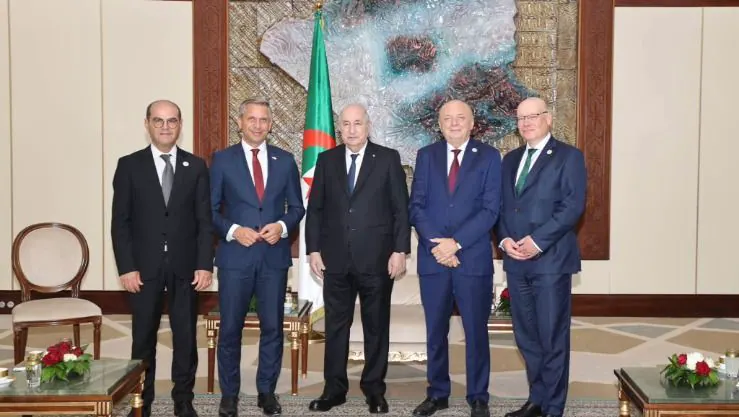
Algerian President Abdelmadjid Tebboune recently welcomed energy ministers from Austria, Germany, Italy, and Tunisia to discuss the SouthH2 hydrogen pipeline project. The meeting was attended by Algerian Minister of Energy and Renewable Energies, Merad Ajal, and other high-ranking officials. The project aims to produce and export hydrogen to participating countries. President Tebboune expressed his support for the initiative, emphasizing its potential to drive economic growth and cooperation among the involved nations.
Italian Minister of Environment and Energy Security, Gilberto Pichetto Frattin, praised President Tebboune's backing for the SouthH2 project, highlighting its significance as a future energy infrastructure. Frattin noted that the project seeks to provide optimal conditions for a better future, not only in terms of energy but also for the well-being of citizens. He expressed his honor in meeting with President Tebboune, who warmly welcomed the ministers and demonstrated his enthusiasm for the project.
Austrian Federal Minister for Economics, Energy, and Tourism, Wolfgang Hattmansdorfer, described Algeria as a "strong partner" for his country. He emphasized that the SouthH2 project is more than just an energy pipeline, but a venture that brings together five nations in the face of global geo-economic shifts. Hattmansdorfer stressed the importance of identifying reliable partners and friends, particularly in today's complex geopolitical landscape.
The SouthH2 project has garnered significant attention due to its potential to reshape the energy landscape in Europe and North Africa. By leveraging Algeria's renewable energy resources, the initiative aims to produce hydrogen for export to participating countries. This endeavor is expected to create new economic opportunities, drive growth, and foster cooperation among the involved nations.
Hattmansdorfer highlighted the project's potential to provide substantial benefits for the Austrian economy, enabling direct investment in Algeria and promoting growth in the renewable energy sector. He emphasized that the project's success would rely on close collaboration with Algeria, Tunisia, and other participating countries. The Austrian minister expressed his confidence in Algeria as a reliable partner, citing the country's commitment to the project.
The meeting between President Tebboune and the energy ministers marks a significant milestone in the development of the SouthH2 project. The project's progress will depend on continued cooperation and dialogue among the participating countries. As the global energy landscape continues to evolve, initiatives like SouthH2 are expected to play a crucial role in shaping the future of energy production and trade.
The SouthH2 project's success could have far-reaching implications for the region, driving economic growth, and promoting sustainable energy development. Key aspects of the project include its potential to create jobs, stimulate investment, and reduce reliance on fossil fuels. As the project moves forward, it is likely to attract significant attention from investors, policymakers, and industry stakeholders.
Key points
- Algeria has been identified as a "strong partner" for Austria in the development of the SouthH2 hydrogen pipeline project.
- The SouthH2 project aims to produce and export hydrogen to participating countries, including Austria, Germany, Italy, and Tunisia.
- The project's success relies on close collaboration among participating countries, with Algeria playing a crucial role in its development.