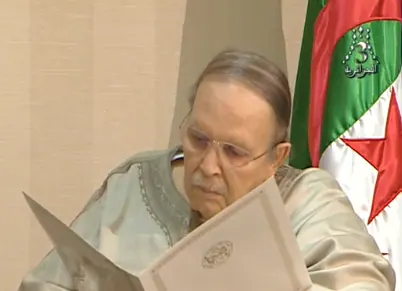
Algerian President Abdelaziz Bouteflika has officially ended his term, notifying the Constitutional Council of his decision. This move comes after the army, led by Chief of Staff Ahmed Gaïd Salah, had urged Bouteflika to step down. By doing so, Bouteflika has opened the way for the application of articles 7, 8, and 102 of the Constitution, which the army had proposed as a solution to the country's crisis.
The army had previously rejected Bouteflika's declaration of resignation, deeming it irreceivable. Gaïd Salah had insisted on the immediate application of the aforementioned articles, warning against "tergiversations" that could lead the country into a constitutional vacuum. The army's stance was made clear in a meeting with commanders of the Forces, military regions, and other high-ranking officials.
Gaïd Salah expressed his concerns over entities that had taken decisions on behalf of the President, which he considered illegitimate. He stated that these entities had no constitutional mandate and were attempting to undermine the country's transition process. The Chief of Staff emphasized that any decision taken outside the constitutional framework would be considered null and void.
The army's Chief of Staff also addressed the issue of corruption and wealth accumulation by certain individuals. Gaïd Salah accused these individuals of engaging in large-scale pillage and dilapidation of the country's resources, amassing immense wealth through illicit means. He vowed that the army would guarantee the security and stability of the country and protect the people from those who had exploited the nation's resources.
Gaïd Salah reiterated his commitment to the Algerian people, stating that he would align himself with their legitimate demands. He emphasized that it was time for the people to regain their constitutional rights and sovereignty. The Chief of Staff also condemned the conspiracies and plots hatched by those who had made a vocation of fraud and malversation.
The application of articles 7, 8, and 102 of the Constitution is expected to pave the way for a transition process in Algeria. The army's intervention has been seen as a significant development in the country's crisis, which was sparked by mass protests against Bouteflika's rule. The situation remains uncertain, with many Algerians eagerly awaiting the outcome of the transition process.
The Algerian people's patience has been tested, and their demands for change have been clear. The army's stance and Gaïd Salah's statements have indicated a commitment to finding a solution within the constitutional framework. As the country navigates this critical period, the international community is watching closely, hoping for a peaceful and stable transition.
Key points
- Algerian President Abdelaziz Bouteflika has officially ended his term, paving the way for a transition process.
- The army, led by Chief of Staff Ahmed Gaïd Salah, had urged Bouteflika to step down and proposed the application of articles 7, 8, and 102 of the Constitution.
- Gaïd Salah has reiterated his commitment to the Algerian people, vowing to guarantee the security and stability of the country and protect the people from corruption and exploitation.