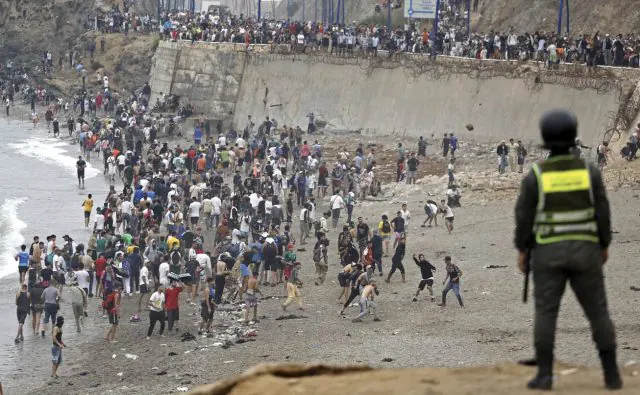
A recent report by Spanish services has revealed that Moroccan military personnel were involved in the invasion of the Spanish enclave of Ceuta. According to documents obtained by El Español, 72 Moroccan military personnel were identified among the invaders. The report describes the Moroccan army as a "center of gravity" for financing and controlling the groups of invaders. The documents include 50 photos of soldiers and officers from Rabat.
The report states that 22 of the identified Moroccan military personnel belong to Rabat's secret services, while 50 others are active military personnel who infiltrated the operation. The behavior of the infiltrated Moroccan military personnel is described as suspicious, with some living in private houses, practicing group sports, and frequently receiving income from across the border. This suggests that they were on a mission.
The reports obtained by El Español detail the behavior of the Moroccan military personnel, describing them as always being attentive to their environment. They were provided with necessities for survival and were tasked with identifying vulnerable points to attack and evaluating the reaction capacity of Spanish forces. Their primary objective was to transmit orders to other soldiers to attack the city and spread fear among Ceuta's inhabitants.
According to El Español, there is no established hierarchy within the structure of the infiltrated Moroccan soldiers. The reports describe them as "centers of gravity," with different types of networks branching out from them. A high-ranking Spanish military official revealed that they observed a trend of people crossing the border with suitcases, staying in a specific location in Ceuta for a short period, and then returning to Morocco.
The Spanish military official also noted that migrants arriving in Ceuta were often well-equipped, carrying large quantities of food and other supplies. This suggested that they were not ordinary migrants but rather individuals with a specific mission. The official stated that the attacks on military personnel were not random acts, but rather part of a coordinated plan.
The reports also highlight the involvement of mafias controlling drug trafficking boats in the region. These mafias have acquired new equipment and are now transporting up to 20 people per trip. This has contributed to Ceuta becoming a hub for drug trafficking into the European market and a gateway for clandestine migrants into the Schengen area.
The identification of the 72 Moroccan soldiers was based on photographs and other evidence. Seven reservists have come forward to confirm their identities. The reports also describe the physical characteristics of the invaders, which do not match those of typical clandestine migrants. The Spanish government has yet to respond to the revelations, but residents of Ceuta are calling for a firm response from Prime Minister Sanchez.
Key points
- Moroccan military personnel were involved in the invasion of Ceuta, with 72 identified among the invaders.
- The Moroccan army was described as a "center of gravity" for financing and controlling the groups of invaders.
- The involvement of mafias controlling drug trafficking boats has contributed to Ceuta becoming a hub for drug trafficking into the European market.