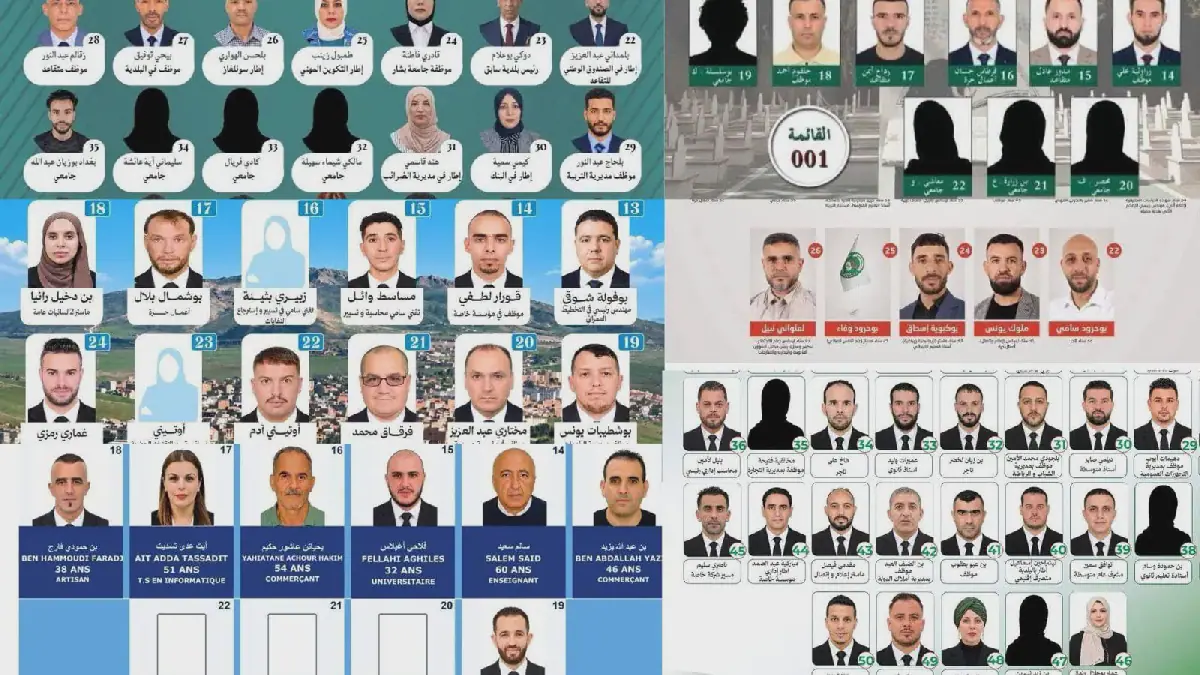
As the Algerian local elections approach on November 28, posters of candidates have been put up across the country. However, some candidates, mostly women, appear without photos or with their faces blurred. This phenomenon has sparked questions about the right of voters to know who they are voting for. The issue has been ongoing since 2012, with some candidates appearing as silhouettes or with blank spaces where their photos should be.
The issue of candidates without photos on posters first arose during the 2012 legislative elections. It gained significant attention in 2017, with some candidates appearing with their faces blurred or as anonymous drawings. The electoral authority intervened in some regions, giving parties 48 hours to change their posters. A representative of the authority stated that it was an attack on the image of women who were running for office and that citizens had the right to know who they were voting for.
In 2021, the National Independent Electoral Authority (ANIE) allowed candidates to opt out of having their photos on campaign posters and ballots. This decision was criticized by some in the press, who argued that it normalized the practice. The phenomenon repeated itself during the 2021 local elections, with many candidates appearing without photos. Some parties also struggled to convince women to join their lists.
Algerian electoral law does not explicitly require candidates to have photos on their posters. However, it does require that advertising space be allocated equally to all candidates in each constituency. The ANIE president has the power to decide on other advertising modalities. In July 2026, the ANIE called for all candidates to publish their lists with photos, citing the principle of equal opportunities.
For the upcoming local elections, the ANIE has not published an equivalent instruction. The authority, now led by Saâd Arous, has not publicly commented on the issue of candidates without photos. Several explanations have been offered for the phenomenon, including candidates' personal or cultural reasons for not wanting to appear on posters.
The issue of candidates without photos has sparked a debate about the role of women in local politics. Some argue that candidates should be identifiable, while others believe that they should have the freedom to choose whether or not to appear on posters. This debate also raises questions about the role of the ANIE in ensuring the smooth running of the electoral process.
The ANIE's decision on the matter could have significant implications for the elections. A clear decision on the issue could help to clarify the rules and ensure that voters have the information they need to make informed decisions. The local elections on November 28 will be an important test of the country's democratic processes.
Key points
- The phenomenon of candidates without photos on posters has recurred in Algerian elections since 2012.
- The ANIE has allowed candidates to opt out of having their photos on campaign posters and ballots in the past.
- The issue has sparked a debate about the role of women in local politics and the responsibilities of the ANIE.