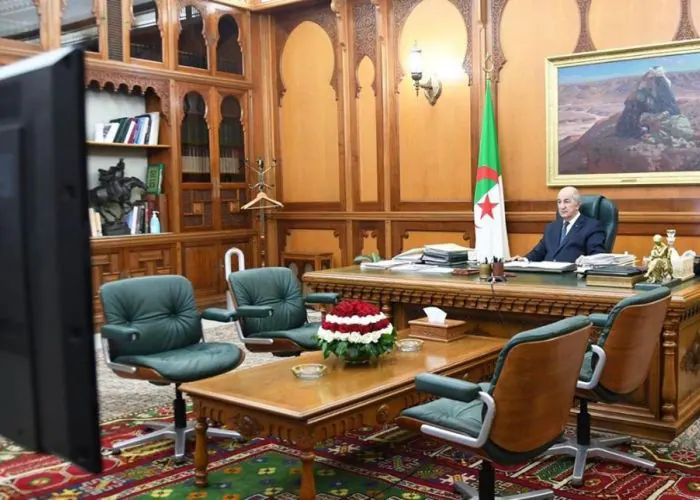
On Sunday, May 10, 2020, Algerian President Abdelmadjid Tebboune chaired an emergency meeting of the Council of Ministers via videoconference. The meeting focused on discussing measures to mitigate the impact of the COVID-19 pandemic on the country's economy and social life. The Council reviewed an amended draft supplementary finance law for 2020, which aims to consolidate purchasing power, improve tax revenue, and encourage foreign investment.
The amended draft law includes several key measures, such as extending a 50% reduction in income tax for southern regions until 2025 and exempting individuals with a monthly income of 30,000 Algerian dinars or less from paying income tax. Additionally, the national minimum wage will increase to 20,000 Algerian dinars starting June 1. These measures aim to alleviate the financial burden on citizens and stimulate economic growth.
To improve tax revenue, the Council approved several measures, including revising the unique flat tax, replacing the wealth tax with a fortune tax, and introducing a progressive tax scale. The Council also discussed compressible charges, donations, and subsidies to encourage economic operators to support national solidarity initiatives in the fight against COVID-19.
The Council also focused on measures to revive the economy, including revising the 49/51 rule, which requires majority Algerian ownership in businesses. The rule will be revised, except for strategic sectors and activities related to buying and selling products. The Council also approved increasing the withholding tax rate for foreign companies operating in Algeria to 30%.
In the education sector, the Council examined a roadmap for the 2019-2020 academic year, proposed by a tripartite ministerial commission. The commission recommended canceling the primary school leaving exam and scheduling baccalaureate and brevet exams for September. The Council also approved a plan to delay the start of the 2020-2021 academic year to October.
The Council's decisions also covered the vocational training and higher education sectors. For vocational training, the start of training sessions for apprentices and trainees registered in February 2020 will be postponed to September. In higher education, the university academic year will start in mid-November 2020, and thesis defenses will be scheduled for June and September.
President Tebboune also announced the launch of a public thematic television channel dedicated to distance learning, which will broadcast via the Algerian satellite Alcomsat-1. The channel will offer courses in various subjects for students in different cycles, particularly those in exam classes.
Key points
- Algerian government approves new measures to mitigate COVID-19 impact on economy and education.
- Measures include tax exemptions, increased national minimum wage, and revised investment rules.
- Education sector to see delayed start to academic year and changes to exam schedules.