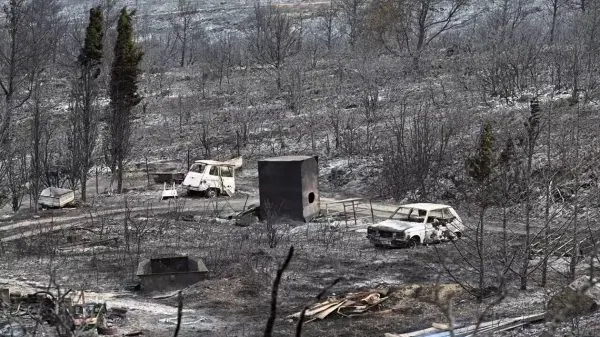
The 2026 summer season has left a lasting impact on Algeria's forests, with a staggering 141,000 hectares of vegetation affected by fires. According to Lieutenant-Colonel Nassim Bernaoui, Sub-Director of Information and Sensitization at the General Directorate of Civil Protection, a total of 1,166 forest fires, 378 maquis fires, and 1,050 incidents of fires affecting underbrush, dry grass, alfa, and mountain crops were recorded. The fires have ravaged over 43,000 hectares of forests and 46,000 hectares of maquis.
The fires have not only destroyed vast areas of vegetation but have also had a significant impact on agricultural land. Bernaoui reported that nearly 2,000 incidents of fires affecting wheat and barley crops were recorded, resulting in the destruction of over 4,000 hectares of wheat and 2,000 hectares of barley. Additionally, 668,000 bundles of hay and over 131,000 fruit trees were lost. The exact number of palm trees affected requires verification, but sources indicate that over 70,000 palm trees were damaged.
The intensity of the fires was unprecedented, with the Civil Protection teams facing a succession of blazes that tested the country's emergency response system. On July 22, 195 fires were recorded within a 24-hour period across several wilayas, with 142 extinguished by the time the report was made. Another peak was recorded at the end of August, with 193 fires declared within 24 hours, of which 147 were extinguished by August 27.
The 2026 season has highlighted the need for a more comprehensive approach to forest fires, according to Bernaoui. He emphasized that forest fires can no longer be viewed as a limited phenomenon confined to the hottest weeks of the year. Instead, preparation and prevention must be ongoing throughout the year, involving training, equipment maintenance, and risk analysis.
In response to the devastating fires, the Algerian government has taken steps to strengthen its emergency response system. The Council of Ministers on September 20 requested the reinforcement of continuous training for Civil Protection agents, modernization of equipment, and a gradual increase in aerial capabilities dedicated to firefighting. A new protocol for forest fires has been established, focusing on personnel training, knowledge recycling, and theoretical and practical exercises.
The new protocol also involves better resource allocation across the territory, with operational units, mobile columns, and regional support detachments mobilized according to the evolving risk. The experience of July and August demonstrated the importance of this organization, particularly when multiple wilayas are affected simultaneously. The regions of Central-East and East concentrated a significant part of the difficulties encountered during the season.
The challenge of mobilizing aerial means was another key lesson learned from the 2026 season. Bernaoui stressed that aerial support requires not only available aircraft but also trained crews and close coordination with ground teams. The government has retained plans to progressively reinforce aerial means for firefighting and create surveillance points and semi-centers in high-density forest areas.
Key points
- Over 141,000 hectares of vegetation affected by fires in Algeria in 2026
- 1,166 forest fires recorded during the 2026 summer season
- Algerian government to reinforce training, equipment, and aerial capabilities to combat forest fires