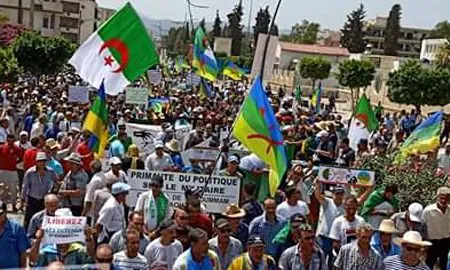
Workers in the education sector in Bejaia, Algeria, are calling for greater involvement in the country's ongoing citizen mobilization, which began on February 22. The main demand is a radical change in the country's political system. Three autonomous unions, the CNAPESTE, SNTE, and UNPEF, which have a strong presence in the education sector in Bejaia, have jointly called for a cyclic strike every Monday, accompanied by a popular march.
The call to action was adopted on September 28 and is not limited to education workers, but is open to all workers across various sectors in Bejaia. The unions are urging all workers to massively participate in the cyclic strike, which is set to begin on the following Monday. The strike will be accompanied by a popular march from the Taos Amrouche cultural center to the Bejaia courthouse. This action aims to push for the effective implementation of the Algerian people's demands.
The demands include the establishment of a transitional process that will ensure social justice in a democratic and republican state. The unions are also calling for the immediate and unconditional release of opinion prisoners, an independent and free judiciary, and respect for individual and collective freedoms. Furthermore, they reject the December 12, 2019, electoral process, which they consider a sham.
The call to action has garnered support from some quarters, but not all education workers are on board. Some argue that the action should be taken at a national level, rather than being limited to Bejaia. One internet user expressed opposition to the strike, stating that it should be a nationwide action if it is to have any impact.
The mobilization in Bejaia is part of a larger movement that began in February, with citizens demanding radical changes in the country's political system. The education sector has been a key player in this movement, with workers seeking better working conditions and greater involvement in the country's decision-making processes.
The CNAPESTE, SNTE, and UNPEF unions have a strong presence in the education sector in Bejaia and have been actively involved in the mobilization efforts. Their call to action is seen as a significant development in the ongoing movement, which is pushing for fundamental changes in Algeria's politics and governance.
As the cyclic strike and popular march get underway, it remains to be seen how the authorities will respond to the demands of the education workers and other citizens. The situation in Bejaia and across Algeria will continue to be closely watched, as the country navigates a period of significant change and uncertainty.
Key points
- The strike and march are aimed at pushing for radical change in Algeria's political system.
- Three autonomous unions, CNAPESTE, SNTE, and UNPEF, have called for the cyclic strike and popular march in Bejaia.
- The action is part of a larger movement that began in February, with citizens demanding changes in the country's politics and governance.