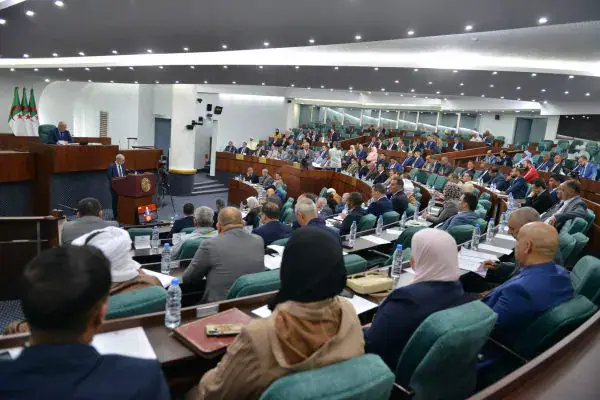
Algeria's Minister of Finance, Mohamed Lamine Lebbou, has presented the country's 2027 finance bill to the National People's Assembly. The proposed budget aims to promote economic growth, improve living standards, and modernize infrastructure. The bill is built around three main objectives: stimulating growth, revaluing citizens' living standards, and financing major public equipment projects. This approach is based on a methodical and prudent assessment of future resources.
The 2027 economic projections are promising, with a forecasted GDP growth rate of 4.2%, driven largely by the vitality of non-hydrocarbon sectors. The state's overall budget revenues are expected to exceed 9,251.1 billion dinars, reflecting a gradual consolidation of the nation's resources. The bill also reaffirms the state's commitment to protecting citizens' purchasing power and quality of life. A total of 2,414.15 billion dinars is allocated to social transfers.
A significant portion of the social transfers, 717.7 billion dinars, will be used to stabilize and support the prices of essential goods and products. This measure aims to protect households from fluctuations in prices. The bill also focuses on promoting employment and supporting the economic fabric. A total of 368 billion dinars is allocated to professional insertion and employment support programs.
The state plans to create 125,675 jobs, including 82,948 direct additional recruitments. The education sector will receive a substantial budget of 1,875.32 billion dinars, with 191.69 billion dinars dedicated to infrastructure investments and the creation of 46,223 new budget posts. The health sector will also benefit from a significant budget of 1,138.72 billion dinars to strengthen healthcare structures nationwide.
The bill allocates 517.5 billion dinars to the housing sector and social housing program. Additionally, 180.4 billion dinars in program authorizations and 37.5 billion dinars in payment credits are allocated to develop new urban poles. These credits will enable the construction of 320 primary schools, 140 middle schools, 77 high schools, and 50 polyclinics.
The government has allocated 3,689.93 billion dinars to major national projects and structuring initiatives. For 2027 alone, 62.4 billion dinars in program authorizations and 360.73 billion dinars in payment credits are mobilized to ensure the continuation of strategic projects. The digital transition is also a transversal lever of efficiency, with 33.55 billion dinars in program authorizations and 24.82 billion dinars in payment credits dedicated to modernizing institutions and digitalizing public action.
The bill emphasizes the rationalization of public funds and good governance, establishing precise rules to strengthen program management efficiency. The strategy involves a prudent expansion of the tax base to consolidate ordinary taxation, coupled with rigorous monitoring of budget execution. The legislative architecture of the bill is built around nine major reform axes, integrating measures to stimulate national investment, safeguard purchasing power, and modernize public services.
Key points
- The 2027 finance bill prioritizes economic sovereignty, purchasing power, and infrastructure modernization.
- Algeria aims to achieve a GDP growth rate of 4.2% in 2027.
- The state will allocate 2,414.15 billion dinars to social transfers to protect citizens' purchasing power.