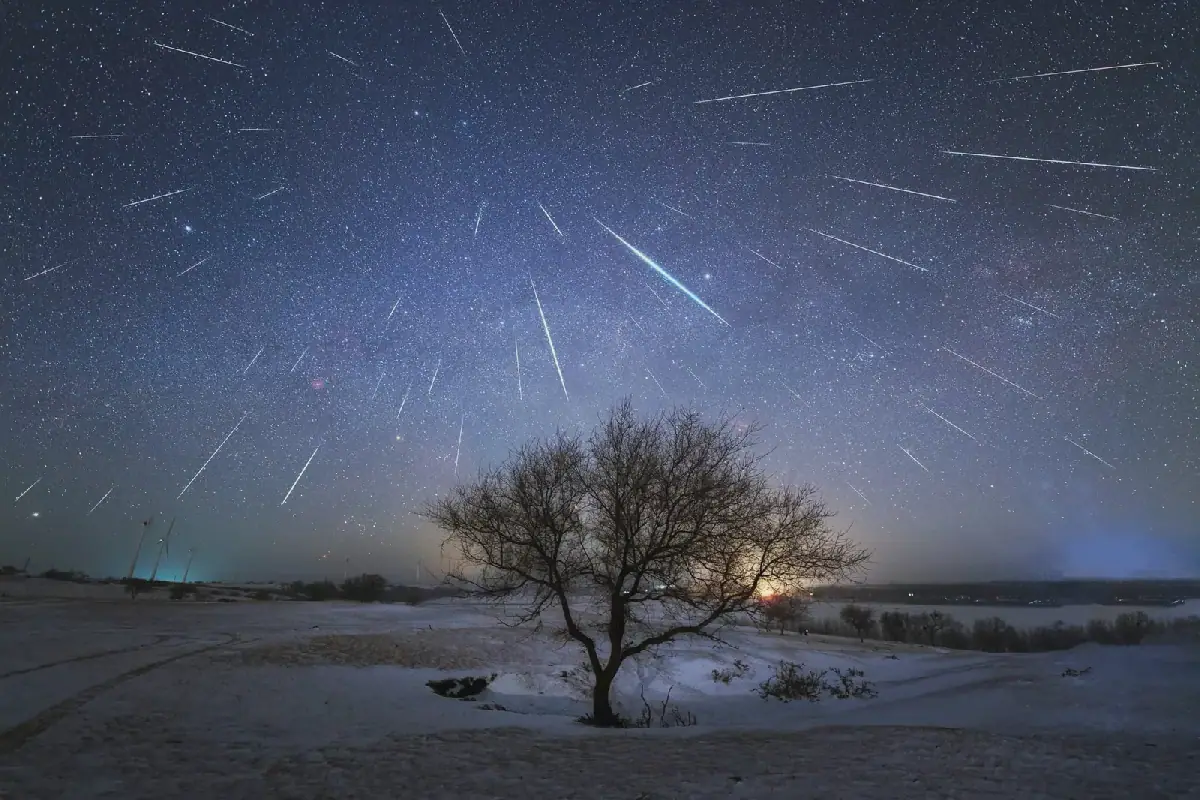
The Algerian sky is set to offer a rare spectacle tonight as dozens of shooting stars traverse the eastern horizon at a record speed of 70 km/s. According to the Centre de Recherche en Astronomie, Astrophysique et Géophysique (CRAAG), the Leonid meteor shower will reach its peak around 5am tonight, with an estimated 20 meteors per hour visible to the naked eye. The CRAAG confirmed the event in a statement released on Monday.
The Leonid meteor shower is active from November 6 to December, but tonight marks the peak of the event. The radiant, or the point from which the meteors appear to originate, will be located slightly north of Regulus, the brightest star in the constellation of Leo. Observers are advised to face east to witness the spectacle. The shower is named after the constellation of Leo, from which the meteors appear to originate.
A key advantage of tonight's event is the absence of lunar interference. The first quarter moon will set below the horizon before the peak of the shower, leaving a sufficiently dark sky to spot even the faintest meteors. This is a more favorable condition than the encounter between the moon and the Pleiades cluster observed in late October, where the lunar brightness dominated the scene.
The Leonid meteors are distinguished by their exceptional speed, penetrating the atmosphere at over 70 km/s, making them the fastest observable meteors from Earth. This results in bright trails, often with a blue and green hue. Some of these trails can linger in the sky for up to five minutes, a phenomenon eagerly awaited by sky photographers.
The Leonid shower also occasionally produces more spectacular events, such as fireballs and grazing meteors. Fireballs are caused by larger-than-average cometary particles, producing longer-lasting and more vivid explosions of light. Grazing meteors, on the other hand, skim the atmosphere at a shallow angle, creating long trajectories across the sky.
To witness the Leonid meteor shower, observers are advised to move away from urban lighting, which can reduce the number of visible meteors. No special equipment is required, and binoculars or telescopes may even limit the field of vision. It is also recommended not to focus directly on the radiant, but rather to observe the meteors at an angle, which can make them appear longer and more impressive.
The Leonid meteor shower is caused by the Earth passing through the debris trail of the comet 55P/Tempel-Tuttle. The comet's elliptical orbit brings it close to the Sun every 33 years, scattering new debris along its path. The Earth crosses this trail every November, resulting in an annual meteor shower. While tonight's event is expected to be a modest one, the shower has produced more spectacular displays in the past, such as the 1966 event, which saw thousands of meteors per minute.
Key points
- The Leonid meteor shower will peak tonight at 5am, with an estimated 20 meteors per hour visible to the naked eye.