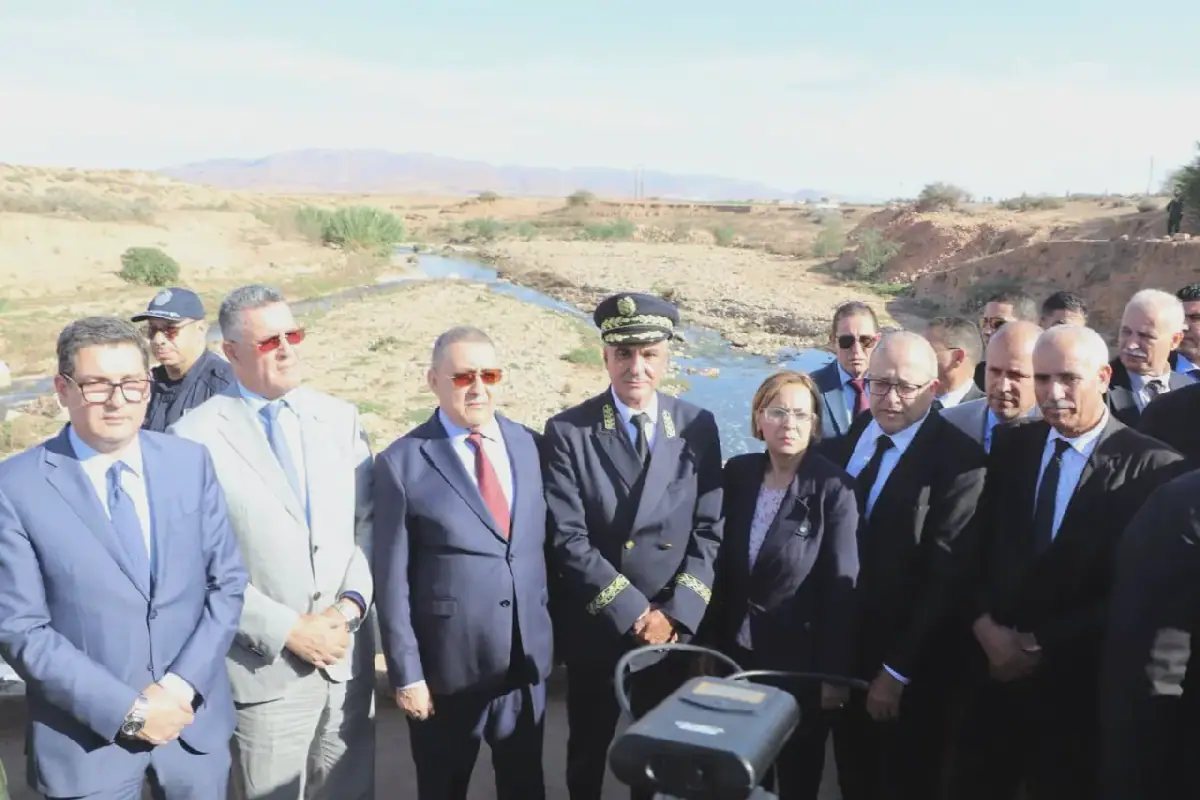
A delegation led by Algerian Minister of Interior Brahim Merad visited Tlemcen province to assess the environmental damage caused by pollution in the region's waterways. The pollution, which originates from Morocco, affects the Mouilah, El Mehaguene, and Abbes rivers, as well as the Hammam Boughrara dam. This situation has raised concerns about public health, water resources, and agricultural activities. The visit was ordered by President Abdelmadjid Tebboune following reports of water quality degradation and fish deaths in the area.
The delegation, which included ministers responsible for hydraulics, environment, health, and communication, met with local officials, experts, and parliamentarians to discuss the issue. They found that the pollution is caused by chemical and microbiological contaminants, including high levels of nitrites, low oxygen levels, and the presence of pharmaceutical and hormonal residues, as well as heavy metals. These pollutants can harm wildlife, vegetation, and human health. The pollution also threatens groundwater, soil, and agricultural land, potentially affecting fertility and crop yields.
Algerian authorities are planning to take measures to address the pollution. Merad stated that the phenomenon is not accidental and constitutes a systematic aggression. He assured that the authorities will take necessary actions to protect the country and its citizens. Parliamentarians from the region have called for the issue to be brought before international authorities and jurisdictions, citing transboundary harm to water resources. They advocate for the activation of legal and diplomatic mechanisms under international water law.
To combat pollution from external sources, Algerian authorities are also investing in infrastructure to reduce urban and industrial waste in the Hammam Boughrara dam basin. A wastewater treatment plant in Maghnia, with a capacity of 29,000 cubic meters per day, is already operational. Another facility, designed to treat industrial wastewater in the Oued Mouilah area, has a capacity of 1,750 cubic meters per day. Additional projects are planned to improve wastewater collection and treatment.
The Algerian government has allocated significant funds for these projects. A project to connect urban wastewater from Maghnia to the treatment plant will require an investment of one billion dinars. The rehabilitation of the existing treatment plant, with an envelope of 1.3 billion dinars, will increase its capacity from 29,000 to 60,000 cubic meters per day. A new station is also planned in the Ouled Mimoun industrial zone to pump industrial wastewater to the Maghnia treatment plant.
An overall study of pollution sources in the Hammam Boughrara dam basin has been conducted to identify contamination sources and define a short-term, medium-term, and long-term intervention program. The study aims to mitigate the effects of pollution on the environment and public health. Algerian authorities have emphasized their commitment to protecting water resources and public health.
The pollution issue highlights the need for cooperation between countries to address transboundary environmental concerns. Algeria's efforts to address the pollution will likely involve coordination with international partners. Key measures will focus on protecting the environment, public health, and water resources.
Key points
- Algeria to address pollution caused by waste from Morocco affecting Tlemcen region
- Algerian authorities to invest in infrastructure to reduce urban and industrial waste
- Issue highlights need for international cooperation on transboundary environmental concerns