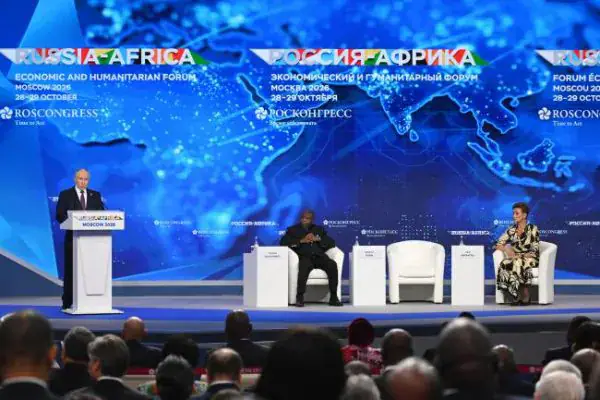
The third Russia-Africa summit kicked off in Moscow, bringing together 48 African countries, with 22 represented at the head of state level. This significant gathering takes place amid ongoing Western sanctions against Russia and a strengthened deployment with African nations. Algeria is set to showcase its vision of a multipolar partnership, maintaining its solid relationship with Moscow.
A considerable security deployment has been put in place for the event, with barricades and a dense police presence securing areas around the Kremlin, hotels, and conference centers. Russian authorities have also considered restricting mobile internet access in several central Moscow districts during the summit. In parallel to the plenary sessions, a Russian enterprise salon has been opened to African delegations, featuring Rosatom's civil nuclear solutions and Rosoboronexport's defense systems.
Algeria's delegation, led by Prime Minister Sifi Ghrieb, includes Minister of State for Foreign Affairs Ahmed Attaf and Minister of State for Hydrocarbons Mohamed Arkab. This lineup reflects Algeria's dual priorities: diplomacy and multilateralism, as well as energy. The Algerian stance on gas and Africa was highlighted at the Gas Exporting Countries Forum (GECF) the day before the summit, where participants adopted a declaration affirming the sovereign rights of exporting states over their natural resources.
Algerian President Abdelmadjid Tebboune emphasized the need to consolidate the GECF's role and strengthen cooperation among its members to ensure market stability and secure supplies amid geopolitical tensions. He highlighted Algeria's position as one of the top ten global gas producers and the second-largest supplier to the European Union via pipeline. Tebboune also mentioned Algeria's program to develop 15,000 megawatts of renewable energy by 2035 and the South Hydrogen Corridor project.
The summit also underscores Russia's growing engagement with Africa, with trade exchanges reaching $27.7 billion in 2025. Russia positions itself as a reliable partner, offering agricultural and energy supplies without political conditionality. Several African states have expressed interest in civilian nuclear cooperation, and Russia presents its approach as respectful of sovereignty and non-interference.
Algeria's stance aligns with this logic of balance, advocating for a multilateral approach to global governance based on international law and rejecting unilateral sanctions. By participating in both the GECF and the Russia-Africa summit, Algeria demonstrates its strategy of diversification, seeking to influence global energy issues while maintaining a structured dialogue with Moscow.
On the African front, Algeria prioritizes continental frameworks and advocates for African solutions to African crises. The country's proactive role in the Russia-Africa summit and its emphasis on energy cooperation reflect its commitment to fostering partnerships that promote stability and development across the continent.
Key points
- Algeria is leading the way in strengthening ties with Russia and Africa, focusing on energy and multipolarity.
- The Russia-Africa summit has brought together 48 African countries, with 22 represented at the head of state level.
- Algeria's participation in the summit reflects its strategy of diversification, seeking to influence global energy issues while maintaining a structured dialogue with Moscow.