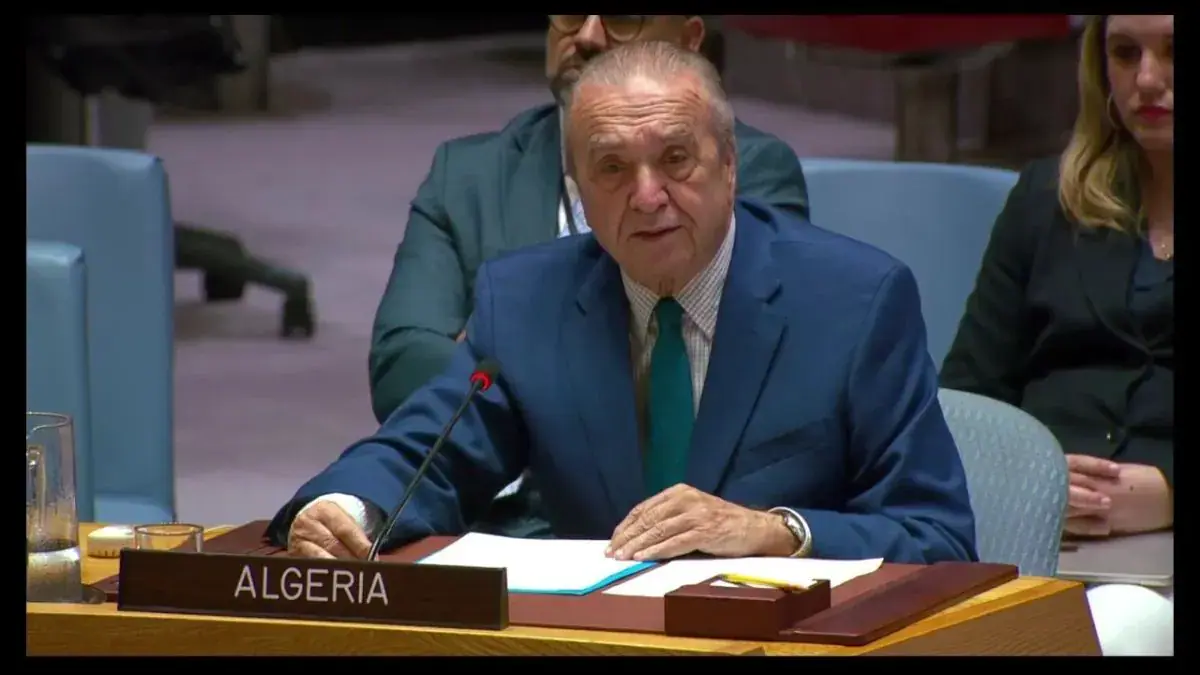
The Algerian government has expressed gratitude towards Russia for vetoing a US resolution to modify the mandate of the United Nations Mission for the Referendum in Western Sahara (MINURSO). On October 30, Russia used its veto power to block the resolution, citing concerns over the potential impact on the Western Sahara conflict. Algeria's representative to the UN, Amar Bendjama, praised Russia's decision, stating that it upheld international law and the principles of the UN Charter.
Bendjama emphasized that Algeria had requested to participate in the UN Security Council meeting as a neighboring country, host to hundreds of thousands of Sahrawi refugees, and as a UN member state committed to international law and the UN Charter. He highlighted six key aspects of the Western Sahara conflict, including self-determination, negotiation, sovereignty, the "fait accompli" of Moroccan occupation, and the humanitarian situation.
The Algerian diplomat criticized the US resolution, stating that it did not meet the criteria for a fair and impartial approach to the conflict. He questioned whether the US had applied the necessary standards in drafting the resolution, which he believed was biased towards Morocco. Bendjama emphasized that self-determination was a fundamental principle for resolving the conflict and that it should not be limited to autonomy under Moroccan sovereignty.
Bendjama also expressed concerns over the negotiation process, stating that it should be a genuine dialogue between parties rather than an imposition of a predetermined solution. He noted that the Polisario Front's proposals and the concerns of Algeria and Mauritania had not been taken into account. The Algerian representative stressed that sovereignty was a binding norm of international law and that it was not for an occupying power to confer property rights on a territory.
The fifth key aspect of the conflict, according to Bendjama, was the "fait accompli" of Moroccan occupation and annexation of Western Sahara. He denounced the US resolution for attempting to legitimize this situation, which he described as a result of an "indecent transaction" at the expense of the Sahrawi people. Bendjama drew parallels with the Israeli-Palestinian conflict, highlighting the suffering of the Palestinian people and the attempts to impose a similar situation on the Sahrawis.
The humanitarian situation in Western Sahara was the sixth and final aspect highlighted by Bendjama. He warned that the proposed initiative, which aimed to involve the UN High Commissioner for Refugees (UNHCR), would result in a "triple penalty" for Sahrawi refugees. This would include the perpetuation of their suffering, a reduction in food rations, and forced displacement. Bendjama emphasized that Sahrawi refugees were human beings, not just numbers.
In conclusion, Bendjama assured that Algeria would continue to promote a just, durable, and mutually acceptable solution to the Western Sahara conflict, guaranteeing the right of the Sahrawi people to self-determination. He emphasized that Algeria had exercised its right to self-determination at a great cost and would continue to support the Sahrawi people's struggle for their rights.
Key points
- Algeria praises Russia's veto on a US resolution to modify the MINURSO mandate.
- The Algerian government sees the Western Sahara conflict as similar to the Israeli-Palestinian conflict.
- Algeria will continue to support a just and durable solution to the Western Sahara conflict.