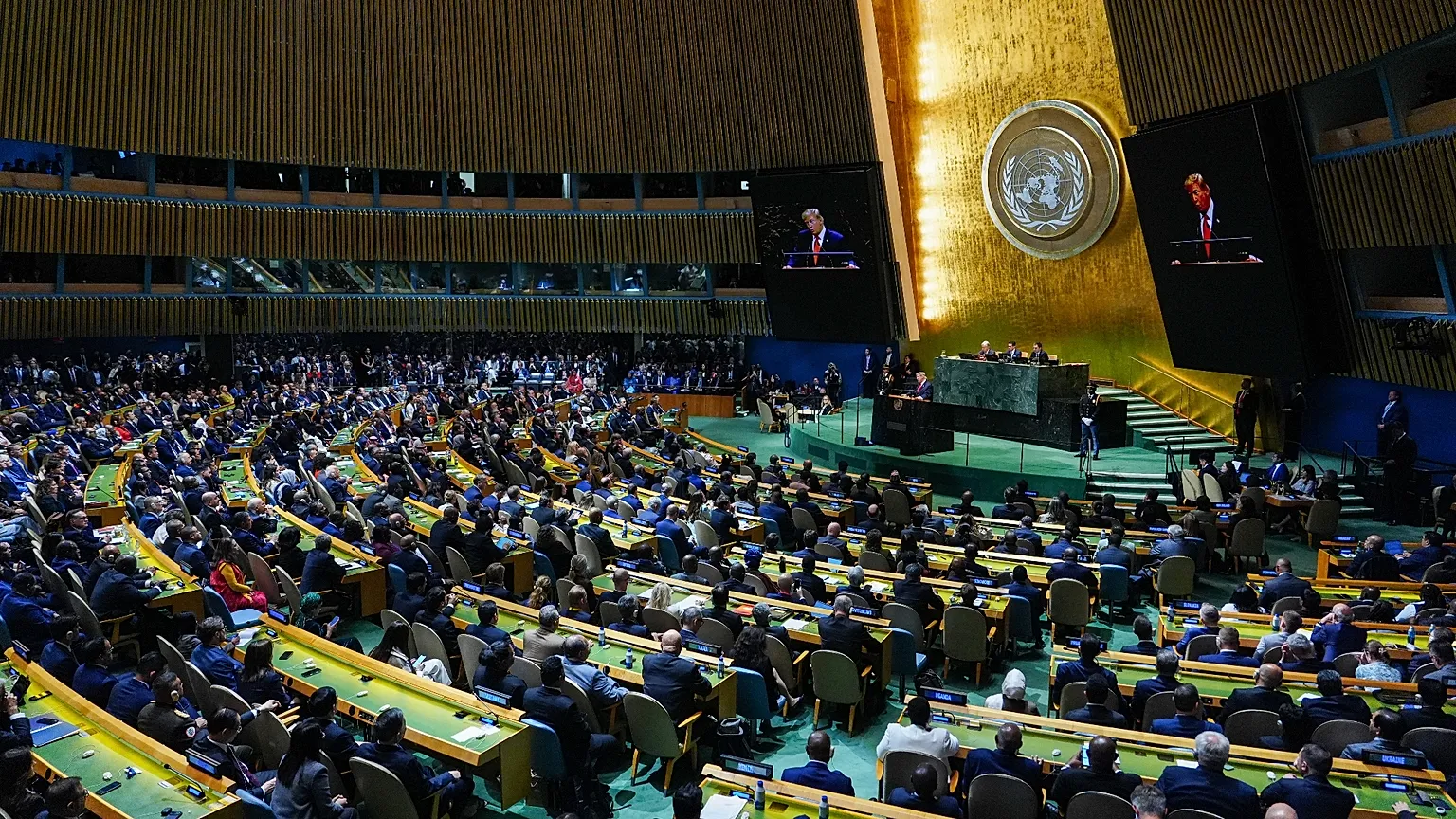
The contemporary international system is marred by structural crises that expose the gap between legal texts governing international relations and the actual practices of major powers. A glaring example is the US's selective treatment of official delegations and personalities attending UN General Assembly meetings in New York. This double standard is starkly illustrated by the US's ease in granting visas to Iranian leaders, despite heightened tensions and proxy wars, while imposing strict restrictions on the Palestinian Authority's leadership.
The legal framework governing New York as the UN headquarters, including the 1947 Host Agreement, obliges the US to refrain from obstructing member state delegations. Iran, as a full UN member, falls under this binding legal scope, forcing the US to grant visas to Iranian officials while imposing security and logistical restrictions within New York. In contrast, the Palestinian Authority's status as a "non-member observer state" leaves room for US administrative and political maneuvering, allowing Washington to consider visa issuance a domestic matter subject to its laws and successive administrations' preferences.
The US uses this leverage to punish the Palestinian leadership for engaging with international courts, such as the International Criminal Court and the International Court of Justice, or for refusing to acquiesce to US political conditions and dictates related to conflict resolution and management. This highlights the first indicator of international law's selectivity, where powerful nations are subject to binding laws, while weaker ones are singled out and excluded from institutional safeguards.
When questioning why over 150 countries that have recognized Palestine, including major European capitals, cannot pressure the US to reverse its visa ban, the answer lies in the nature and limitations of diplomatic recognition. Recognition is a political, moral, and legal acknowledgment but does not negate the fact that each country has absolute sovereignty over its borders and entry points. No country, including France, Spain, or Norway, can legally compel the US to admit a particular individual, as immigration laws and visa policies are a red line for domestic national sovereignty.
Diplomatic recognition, in itself, lacks coercive power, such as economic sanctions or military deterrence. European countries, for instance, prioritize their strategic, security, and economic partnerships with the US, making them hesitant to engage in significant confrontations with Washington over a Palestinian leader's visa. Instead, they opt for mild diplomatic protests or expressions of disappointment, avoiding a substantial impact on US policies.
The international community often resorts to middle-ground solutions to circumvent diplomatic embarrassment. Rather than compelling the US to respect the Palestinian delegation's immunity, the UN General Assembly's rules are modified to allow the Palestinian leader to deliver his speech via video conference. While this preserves a minimal level of access, it dissipates genuine international pressure and leaves occupation and US intransigence without tangible consequences.
Evaluating international recognition of Palestine requires considering both strategic dimensions and on-the-ground realities. Recognition provides a legal and legitimacy shield, thwarting attempts to erase Palestinian identity and transforming the issue into a mere humanitarian or internal security concern. It also enables Palestine to join international organizations and prosecute the occupation in international courts, isolating US and Israeli policies globally.
Key points
- Algeria criticizes double standards in international diplomacy.
- The US's selective treatment of Palestinian and Iranian leaders highlights these double standards.
- Diplomatic recognition of Palestine lacks coercive power to enforce its implementation.