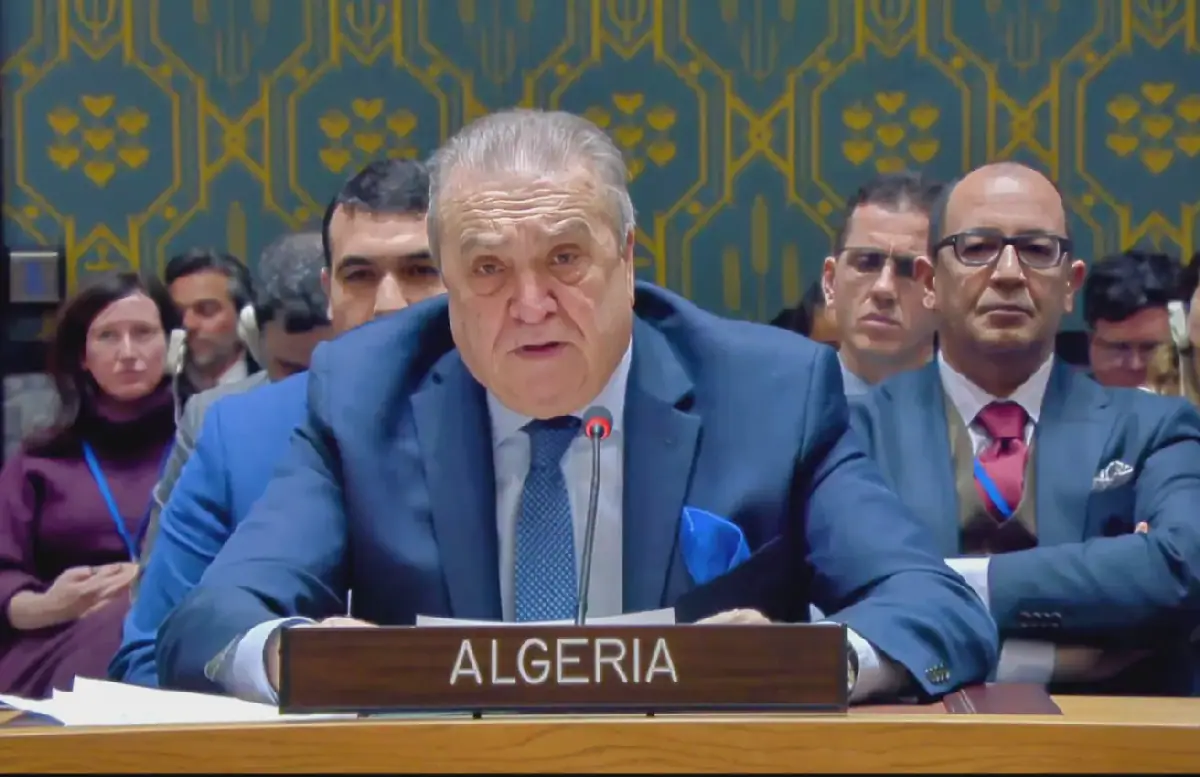
Algeria's Ambassador to the United Nations, Amar Benjamme, has stated that a self-determination referendum has always been a cornerstone for resolving the Western Sahara conflict. He made these remarks during a UN Security Council meeting on Friday, in response to Russia's veto of a US-drafted resolution on Western Sahara. Benjamme expressed gratitude to Russia for its vote and to countries that chose not to support what he described as a "clear injustice" and a "stain on the foundations of our Organization."
The UN Security Council meeting was convened to discuss the Western Sahara conflict, which has been ongoing for 50 years. Algeria participated in the meeting as a neighboring country affected by the conflict and as the host of hundreds of thousands of Sahrawi refugees. Benjamme emphasized the need for a peaceful resolution to the conflict, which has been a source of tension in the region. The conflict began in 1975, following the withdrawal of colonial power Spain from Western Sahara.
Russia used its veto power to block the US-drafted resolution, which would have reduced the military presence of the UN's MINURSO mission and endorsed Morocco's autonomy plan as a basis for negotiations. Eleven council members supported the resolution, while three abstained. In response, Russia introduced its own draft resolution, which would have extended the MINURSO mission's mandate for another year. The US voted against it, and 11 members abstained.
The Moroccan Royal Court reacted to the failure to extend the MINURSO mission's mandate by stating that it should put an end to the involvement of the Security Council in the issue and remove it from the council's agenda. The court added that the continued presence of MINURSO in the southern regions of Morocco, including its personnel, vehicles, equipment, and symbols, should come to an end in the coming days. The MINURSO mission was established in 1991 to oversee a ceasefire between Morocco and the Polisario Front.
The MINURSO mission's primary objective was to prepare for a referendum on the self-determination of Western Sahara. However, the referendum has been delayed several times, and the mission's mandate has been extended repeatedly. The conflict has led to a humanitarian crisis, with hundreds of thousands of Sahrawi refugees living in camps in Algeria. Algeria has long been a supporter of the Sahrawi cause and has called for a peaceful resolution to the conflict.
The Western Sahara conflict has been a major issue in North African politics for decades. The conflict has pitted Morocco against the Polisario Front, which seeks independence for Western Sahara. The African Union has been involved in efforts to resolve the conflict, but a lasting solution has yet to be found. The UN has maintained a presence in Western Sahara since 1991, but its efforts have been hindered by disagreements between the parties.
The situation in Western Sahara remains uncertain, with no clear solution in sight. The failure to extend the MINURSO mission's mandate has raised questions about the future of the UN's involvement in the conflict. Algeria has reiterated its commitment to finding a peaceful resolution to the conflict, based on the principles of self-determination and international law.
Key points
- Algeria's UN representative emphasizes the importance of a self-determination referendum in resolving the Western Sahara conflict.
- Russia's veto of a US-drafted resolution on Western Sahara has raised questions about the future of the UN's involvement in the conflict.
- The Moroccan Royal Court has stated that the end of the MINURSO mission's mandate should put an end to the involvement of the Security Council in the issue.