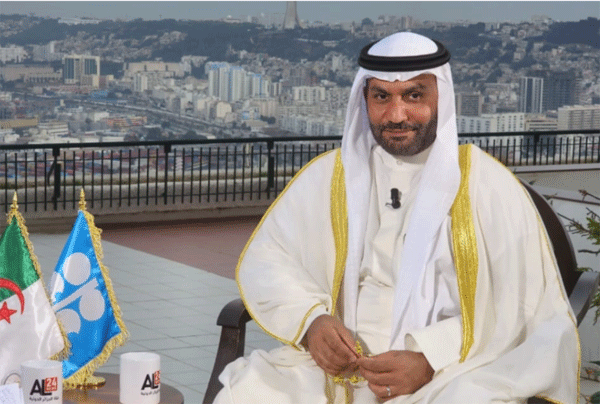
The Secretary-General of the Organization of the Petroleum Exporting Countries (OPEC), Haitham Al-Ghais, has highlighted Algeria's crucial contribution to global oil market stability. Speaking in Algiers, Al-Ghais emphasized that Algeria's agreement, reached ten years ago, was instrumental in restoring balance to the market after a prolonged period of instability. This agreement has become a cornerstone for the Declaration of Cooperation between OPEC and non-OPEC producers, known as OPEC+.
Al-Ghais praised Algeria's historical and significant role in the oil market, noting that the country's efforts have been pivotal in shaping the global energy landscape. He recalled that the Algerian agreement was a turning point in international oil cooperation, marking the beginning of a new era of collective action between OPEC and non-OPEC producers. This cooperation has led to the establishment of OPEC+, a key mechanism for coordinating efforts to support global oil market stability.
The OPEC Secretary-General stressed that the Algerian agreement was a response to the turbulent international context, characterized by significant market fluctuations and declining prices. He commended the success of this initiative, which brought together OPEC member countries and ten non-OPEC countries. Al-Ghais noted that the decision to launch a genuine and constructive dialogue with non-OPEC producers was essential in rebalancing the market.
Algeria's role in OPEC+ has been marked by its consistent commitment to dialogue and cooperation. Al-Ghais highlighted that Algeria's contributions reflect its long history of engagement in international oil dialogue and its achievements in this field. He expressed satisfaction with Algeria's continued efforts to foster dialogue and cooperation within OPEC+.
The OPEC Secretary-General emphasized that the OPEC+ cooperation framework has been highly successful, enabling the maintenance of acceptable oil inventory levels and market balance. He underlined the need to continue this cooperation, given the rapidly changing global energy landscape and the challenges posed by economic and geopolitical fluctuations.
Al-Ghais also noted that the cooperation born out of the Algerian agreement has expanded to cover other areas, including the exchange of expertise, technology, and research. He highlighted the importance of continued collaboration between producers in the face of accelerating changes in global energy markets.
Looking ahead, Al-Ghais expects the global economy to grow steadily, driving up demand for oil. He forecast that the global economy will double in size by 2050, driven primarily by the growth of developing economies, which will increase oil demand to 124 million barrels per day, up from around 105 million barrels per day currently.
Key points
- Algeria's agreement ten years ago was instrumental in restoring balance to the global oil market.
- OPEC+ cooperation has been successful in maintaining market stability and acceptable inventory levels.
- Continued cooperation between producers is essential in the face of rapidly changing global energy markets.