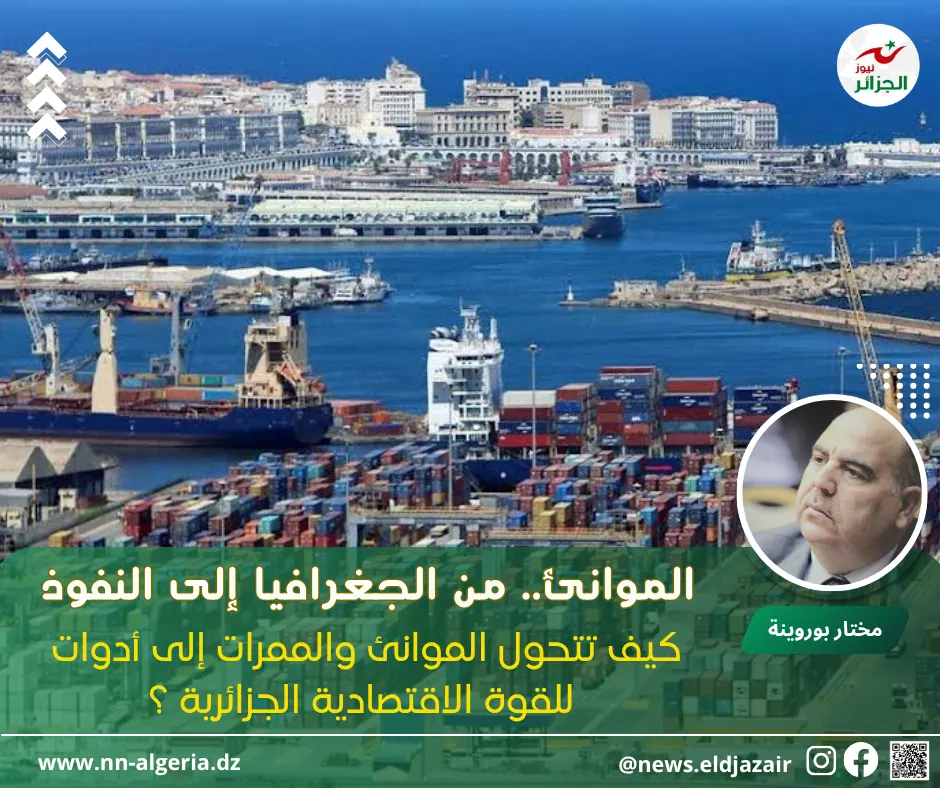
In the 21st century, the sea has become a significant arena for geo-economic competition, with ports evolving from simple docking facilities to strategic hubs where trade, energy, industry, data, transportation, and finance intersect. Algeria, with its unique geographical location, faces the challenge of converting its natural advantages into economic value and regional influence. The country's ports are crucial for its economic development, but the question remains whether Algeria can leverage its geographical position to create a competitive and influential economic presence.
Historically, global influence has been linked to control over the seas, energy sources, and trade routes. Today, the competition is shifting towards something more complex: networks. Global trade no longer moves just from port to port but through interconnected systems of container terminals, shipping companies, logistics areas, warehouses, digital platforms, and service providers. The majority of global commodity trade still occurs by sea, but maritime trade faces increasing pressures due to geopolitical tensions and disruptions in some shipping routes.
The value of a port's location is no longer solely determined by its proximity to trade lines but also by its ability to provide flexibility, speed, security, and connectivity. In a turbulent world, a good port is not just one that accommodates the largest ships but also one that shipping companies can rely on. This transformation has redefined the role of major shipping companies, which have expanded their activities to include container terminals, logistics services, warehousing, land and rail transport, and digital solutions.
The relationship between the state and shipping companies is changing, with ports becoming part of an international economic network involving giant companies that own technology, expertise, networks, and markets. This does not mean that foreign investment is a threat in itself; the key issue is the terms of partnership. A state with infrastructure but without the ability to manage partnerships risks turning strategic assets into tools of external influence.
Algeria has begun to address these issues, with recent developments indicating a shift towards understanding the importance of networks and distributing functions. In September 2026, the Minister of Interior, Local Communities, and Transport, Saïd Saïd, announced during a visit to the port of Mostaganem that the construction of a third basin for the port had become an urgent necessity. Authorities consider that dredging the first and second basins and deepening them to nine meters is still insufficient for significant port activity.
The proposed project for Mostaganem port not only includes a new basin but also a new dock and a water depth of up to 15 meters, allowing it to accommodate ships with cargoes of up to 60,000 tons or possibly 80,000 tons. At the same time, the port's logistics hub is being reinforced with storage platforms, handling equipment, cranes, distributors, and electro-mechanical sets, valued at approximately 8 billion dinars. These developments reveal a change in thinking, with the port no longer viewed as just a dock to be deepened for larger ships but as a link in a system extending from the sea to storage, handling, customs, transport, and markets.
The Algerian government's approach to specializing ports at the national level aims to enhance their efficiency and performance. The fundamental idea is that port power comes not from having all ports similar but from having complementary functions. If one port becomes more specialized in a certain function, another in containers and transshipment, a third in energy or minerals, and a fourth in serving an industrial area or regional market, then these ports collectively can perform a much greater function than a set of facilities operating in the same way.
Key points
- Algeria aims to transform its ports into strategic hubs to boost economic influence
- The country's geographical location is crucial for its economic development
- Specializing ports could enhance their efficiency and performance