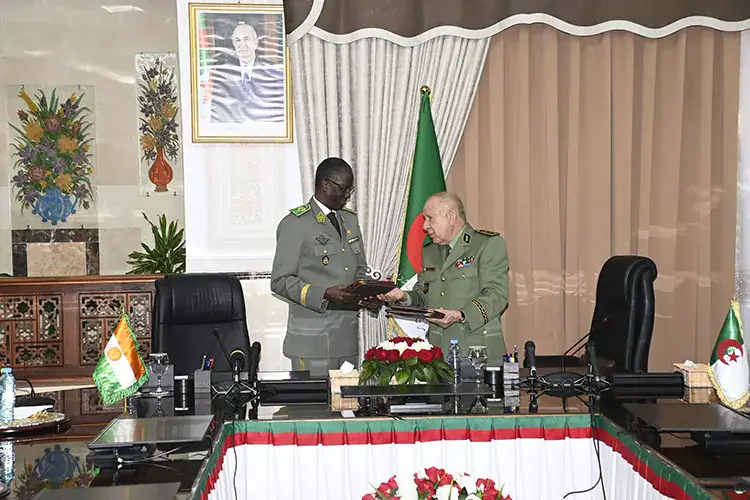
The European Union's request for clarification on Algeria's military deployment in Niger has sparked strong criticism in Algeria. The agreement, which was approved by the Algerian parliament, is a bilateral military deal between two independent countries and does not require EU approval or oversight. Algerian officials and experts argue that the EU's request is an overstep of its authority and an attempt to exert influence over the country's sovereign decisions.
The EU's stance on the matter has raised questions about the extent of its influence in the Sahel region. The EU's spokesperson for foreign affairs and security policy, Anar El Annani, stated that the EU is closely monitoring the situation and expects clarification on the scope, objectives, and basis of the Algerian military deployment. However, Algerian experts argue that the EU has no right to request such clarification, as the agreement is a bilateral matter between Algeria and Niger.
Former Algerian ambassador Abdelaziz Rahabi criticized the EU's stance, questioning the basis for its request for clarification. He argued that the EU's move is an attempt to exert control over Algeria's foreign policy and security decisions. Rahabi also warned that this approach could lead to a situation where the EU is required to provide similar clarification to Algeria on its own security arrangements.
Another expert, Lakhdar Razak Berra, linked the EU's stance to the changing dynamics in the Sahel region. He argued that some European capitals have not yet adjusted to the new reality in the region, where Algeria is taking a more proactive role in protecting its strategic interests. Berra also suggested that the EU's move may be driven by a desire to undermine Algeria's growing influence in the region.
The controversy surrounding the EU's request for clarification comes as Algeria and Niger are strengthening their cooperation on various fronts. The two countries are working together to address common security and economic challenges, including the threat of terrorism and smuggling networks. Algerian officials argue that their military cooperation with Niger is a sovereign decision that does not require external approval or oversight.
Military expert Toufik Hamel argued that Algeria's security strategy has evolved in response to changing threats in the region. He noted that the country's traditional approach to security, which focused on protecting its borders, is no longer sufficient to address the complex threats facing the region. Hamel suggested that Algeria's military deployment in Niger is part of a broader strategy to protect its strategic interests and secure its neighborhood.
The debate over the EU's request for clarification on Algeria's military agreement with Niger highlights the complex dynamics at play in the Sahel region. While Algeria and Niger are working together to address common challenges, external actors such as the EU are seeking to exert influence over the region's security arrangements. The outcome of this controversy will likely have implications for the region's security landscape and the role of external actors in shaping its future.
Key points
- Algeria rejects EU oversight on military agreement with Niger, citing sovereignty and bilateral nature of the deal.
Reporting sources
- لا وصاية أوروبية على الاتفاق السيادي بين الجزائر والنيجر · echoroukonline.com