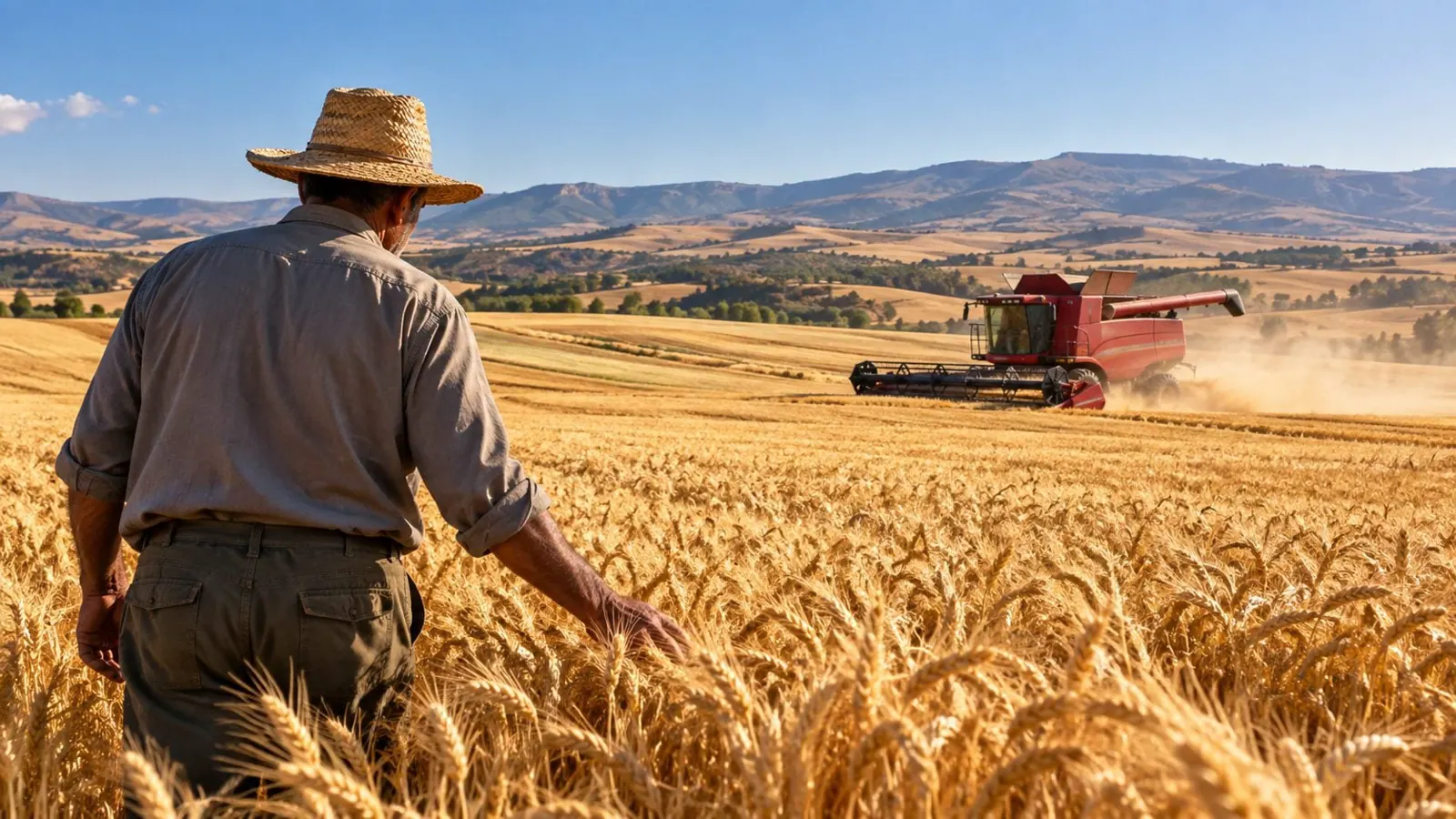
Algeria's Minister of Agriculture, Sid Ali Khaldi, has announced plans to revise the country's agricultural law, aiming to boost food production and reduce reliance on imports. The new law, expected to be more effective, will prioritize crop production based on national needs. Khaldi has emphasized the importance of achieving food sovereignty, citing that every ton of wheat produced locally will reduce the country's import bill. He has set four key objectives for the upcoming agricultural season: increasing production, improving quality, protecting farmers, and making data-driven decisions.
The new agricultural law is part of President Abdelmadjid Tebboune's efforts to achieve food security and reduce imports. On September 20, Tebboune chaired a meeting of the Council of Ministers, where he requested a more effective agricultural law that would allocate land for various crops based on national needs. He also called for immediate measures, including a monthly report on cereal production, digital payment of harvests to the Algerian Interprofessional Cereals Office (OAIC), and a national program for soil mapping and study.
The previous Minister of Agriculture, Yacine El Mahdi Oualid, had presented a draft of the new agricultural law in March, which included several key axes, such as reforming subsidies, preserving local genetic resources, and improving coordination between production, storage, transformation, and distribution. The draft law aimed to shift subsidies from inputs to production and performance, rewarding farmers for their yields. However, it is unclear whether Khaldi will adopt this draft in its current form.
The current agricultural law, enacted in 2008, sets out to improve food security and provides for agricultural maps, youth installation, and pilot farms. It also established agricultural orientation schemes and observatories to monitor production and regulate markets. However, the law has limitations, and the Ministry of Agriculture has announced plans to revise it to address issues such as land concession and agricultural subsidies.
Algeria's dependence on wheat imports is a significant concern, with the country importing around 14.6 million tons of cereals, including 5 million tons of maize, for the 2025-2026 campaign. The government aims to increase domestic production, particularly of wheat, to reduce the import bill. The Ministry of Agriculture plans to extend cultivated areas, introduce more climate-resistant wheat varieties, and provide training for farmers.
The new agricultural law will need to go through several stages before its adoption, including consultation with stakeholders, approval by the Council of Ministers, and ratification by Parliament. The government has not announced a specific timeline for the law's adoption. However, with the concerted efforts of the Ministry of Agriculture and other stakeholders, Algeria hopes to achieve food security and reduce its reliance on imports.
The Algerian government has also launched several initiatives to support agriculture, including a project to promote organic farming, which is expected to receive €1 million in funding from the European Union. Additionally, a major agricultural project in Timimoun, worth €420 million, is underway, which is expected to create 6,700 jobs and boost the country's agricultural production.
Key points
- The new agricultural law aims to increase domestic food production and reduce Algeria's reliance on imports.
- The law will prioritize crop production based on national needs and provide support to farmers.
- Algeria's dependence on wheat imports is a significant concern, with the country importing around 14.6 million tons of cereals for the 2025-2026 campaign.