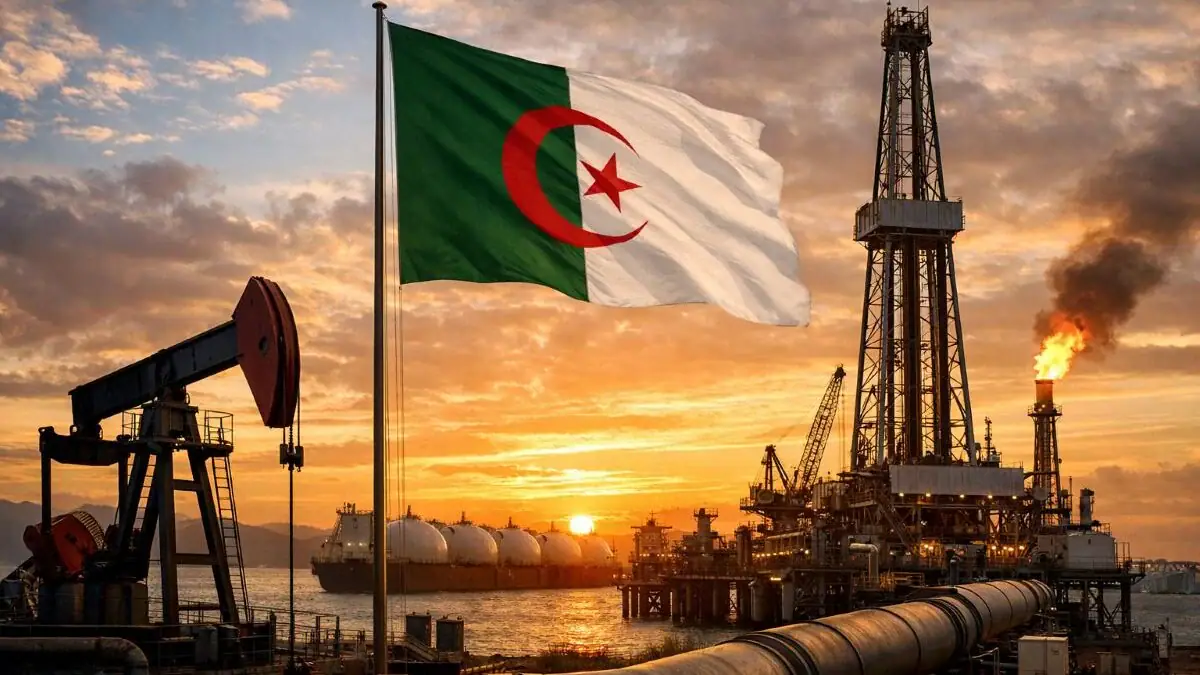
The African Energy Chamber's annual report on the continent's energy outlook has ranked Algeria as the top producer of hydrocarbons in Africa, alongside Nigeria. According to the report, which was compiled using data from S&P Global Commodity Insights up to the summer of 2025, Algeria's production in 2024 was approximately 3.3 million barrels of oil equivalent per day. This was almost evenly split between liquids and gas, with crude oil accounting for around 1.38 million barrels per day.
The report forecasts that Algeria's oil production will remain stable at around one million barrels per day in 2026, with gas production expected to reach 10 billion cubic feet per day, equivalent to approximately 283 million cubic meters. The country, along with Nigeria, is expected to continue as one of the top two producers in terms of existing volumes. Across the continent, production is expected to remain steady at 11.4 million barrels of oil equivalent per day in 2026, before rising to 13.6 million by 2030, with around 60% of this coming from North Africa.
Algeria also ranks third in Africa for recoverable gas reserves, with 91,495 billion cubic feet, behind Mozambique and Nigeria. In terms of liquid reserves, the country ranks third with 13,490 million barrels. Four Algerian basins feature in the continental ranking: the Tilrhemt uplift, Ghadames, Illizi, and Hassi Messaoud. Sonatrach, the national energy company, has the largest reserves of liquids on the continent, with 11,094 million barrels, ahead of TotalEnergies.
The company is also the second-largest holder of gas reserves, with 68,640 billion cubic feet. In 2024, 14 hydrocarbon discoveries were made, largely driven by exploration by Sonatrach and Eni in the Hassi Messaoud and Berkine basins. Two gas developments are expected to come online in 2026: Tin Fouyé Tabankort Sud and In Amenas II. The government has set a target of producing 200 billion cubic meters of gas per year within five years, with half of this destined for export.
Algeria is also investing heavily in petrochemicals, with Sonatrach preparing to launch a new complex for the production of methyl tert-butyl ether (MTBE), a key additive in the manufacture of unleaded gasoline. The project, which has been awarded to a Chinese consortium, has an estimated investment of around $500 million and will have an annual capacity of 200,000 tonnes. Once fully operational, the plant is expected to meet domestic demand and provide surplus quantities for export.
The development of Algeria's energy sector is part of a broader strategy to diversify the country's economy and reduce its reliance on imports. The government aims to increase the country's petrochemical production and become an exporter of MTBE. According to a Sonatrach official, construction on the MTBE plant is complete, with production expected to start in early 2027.
The outlook for Algeria's energy sector remains positive, with several projects in development, including the Bourarhet Nord oil field, which is awaiting a final investment decision in 2026, with production expected to start in January 2030. The country's energy sector is expected to continue to play a significant role in the country's economy, with the government aiming to maximize the benefits of its hydrocarbon resources.
Key points
- Algeria ranks as the top producer of hydrocarbons in Africa, alongside Nigeria.
- Sonatrach has the largest reserves of liquids on the continent, with 11,094 million barrels.
- The country aims to produce 200 billion cubic meters of gas per year within five years, with half of this destined for export.
Reporting sources
- Hydrocarbures : l’Algérie garde son rang de premier producteur africain · maghrebemergent.com