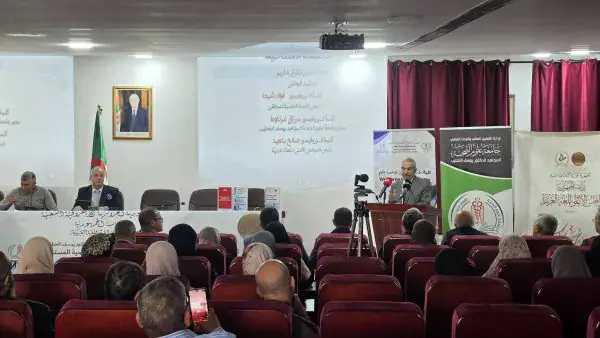
The Conseil supérieur de la langue arabe and Université des sciences de la santé "Moudjahid Dr-Youssef-El-Khatib" recently hosted a national colloquium in Algiers to discuss the role of the Arabic language in medical education, clinical knowledge transmission, and medical documentation. This initiative aims to promote Arabic as a tool for transmitting medical knowledge and facilitating communication between healthcare professionals and patients.
The colloquium brought together medical professionals from various Algerian universities, specialists from Arab countries, professors of surgery, linguists, and pharmacists to share experiences, develop partnerships, and propose consensual solutions for using Arabic in medical sciences. Salah Belaïd, president of the Conseil supérieur de la langue arabe, emphasized that this effort goes beyond linguistic concerns, representing a cultural endeavor that reflects Algeria's commitment to its national identity and scientific independence.
Belaïd argued that Arabic has the capacity to adapt and enrich itself, allowing it to meet the demands of contemporary scientific terminology. He cited existing initiatives by some Algerian universities and medical laboratories that have successfully incorporated Arabic into their activities, calling for these efforts to be consolidated and expanded.
Fouad Chiha, president of the colloquium's scientific committee, noted that the 21st century has seen significant transformations in the medical field, including advances in genomics, targeted therapies, and artificial intelligence applications. Chiha stressed the challenge faced by researchers engaged in the Arabization of medical sciences, who must integrate these new developments into the Arabic scientific and cultural context.
The use of Arabic in clinical explanations, diagnostic reasoning, and health documentation is also a practical necessity, according to Chiha. This facilitates the establishment of trust between healthcare professionals and patients, improves the understanding of medical information, and enhances the quality of care.
Merzak Ghernaout, rector of the Université des sciences de la santé, highlighted the importance of Arabic as a pillar of Algerian identity and civilization, with a rich historical heritage in scientific and medical fields. Ghernaout emphasized that developing medical education and research requires supporting initiatives that strengthen the presence of Arabic in academic and hospital environments.
The colloquium featured several presentations addressing various aspects of promoting Arabic in medical education, including the impact of using Arabic, the language of medico-legal reports, and the potential of artificial intelligence to support the Arabization of medical terminology.
Key points
- The Algerian government aims to promote the use of Arabic in medical education and healthcare to strengthen national identity and scientific independence.
Reporting sources
- Enseignement de la médecine : Le défi de l’arabisation · Le Jeune Indépendant